Get a Quote
← All Guides
Home / Guides / Disc vs Tube Diffuser
Aeration selection

Disc diffuser
vs tube diffuser

Two shapes of the same idea. The performance argument between them is smaller than the layout argument, and layout is where most projects are actually decided.

Fine bubble disc diffuser on an aeration grid
The starting point

Same physics, different geometry

Before comparing anything, it is worth being clear that this is not a choice between two technologies.

Both a disc diffuser and a tube diffuser are fine-bubble membrane diffusers. Air passes through a perforated elastic membrane and breaks into bubbles typically in the 1–3 mm range. The perforation, the membrane material and the support tube are broadly the same idea in both.

What differs is the shape of the unit and therefore the shape of the bubble field. A disc is a short, round emitter that covers a small footprint and can be placed almost anywhere on a grid. A tube is long and directional: it produces a curtain of bubbles along its length, which is excellent for inducing a rolling circulation in a long basin and awkward in an irregular tank.

So the real question is not "which transfers more oxygen" but "which shape fits this basin, this header route and this maintenance access".
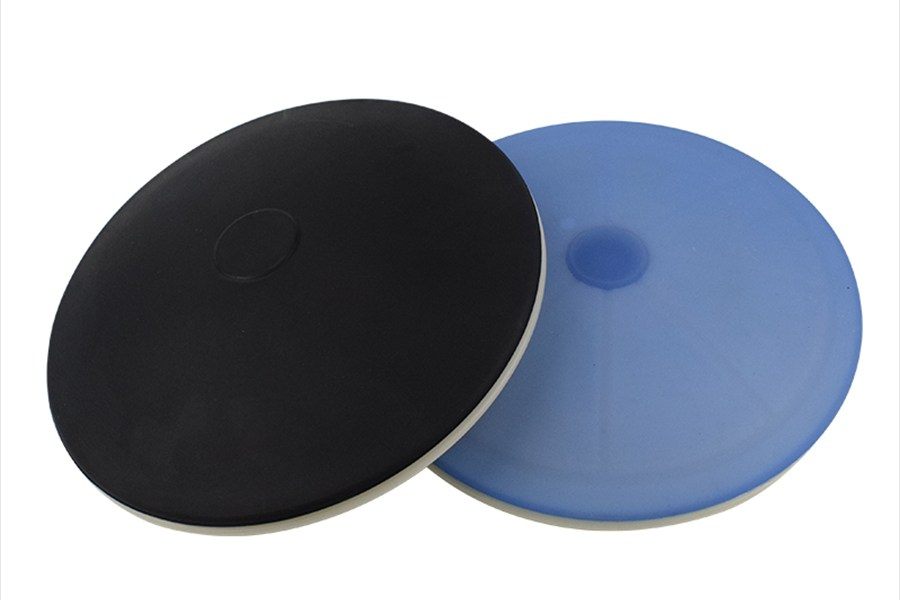
Side by side

The comparison that decides it

Qualitative on purpose - every basin has a different plan shape, depth and airflow profile, so a single efficiency number for either type would be misleading.

QuestionDisc diffuserTube diffuser
GeometryShort round emitter, 215 / 260 / 300 mm diameterLong cylinder, 69 mm OD, 580 / 800 / 1000 mm lengths
Bubble fieldPoint source on a grid; very even coverage when densely spacedLine source; produces a curtain along its length and drives a rolling pattern
Best basin shapeSquare or rectangular, regular grid layoutLong, narrow channels; deep tanks; irregular tanks where the main runs along one wall
Floor area per unitSmall - needs more units for the same areaLarge - fewer units for the same area, so fewer piping connections
ReplacementIndividual - unbolt the retainer and lift the membraneWhole unit off its saddle - needs more headroom and a longer isolation
TurndownNarrower range before the membrane stops opening fullyWider range - more perforated length to open
Typical fouling pointPerimeter, where the membrane seatsUnderside, if the airflow runs too low to open the membrane
Typical applicationAerobic tanks, aerated biofilters, aquacultureMunicipal sewage and organic industrial wastewater aeration
Decision

How to actually choose

01

Draw the basin and the header route

If the existing or planned air main runs down one wall, a tube is a much shorter pipe run. If it runs down the centre with laterals, a disc grid is usually tidier.

02

Check the headroom for removal

This decides more projects than any performance figure. A tube needs clear space above the saddle to be lifted out as a unit. If the basin is shallow or cluttered with pipework, a disc wins by default.

03

Look at the airflow range, not the design point

Write down the airflow at peak and at the lowest load the plant will actually see. If the minimum is low enough that a short membrane will not open, either specify a tube or accept that the discs will foul.

04

Match the membrane to the stream

EPDM for municipal and most organic industrial streams. Silicone where the stream is hot or carries solvents. The membrane is consumable in both cases - choose it against the real waste stream, not a generic datasheet.

Reference figures

Our current ranges

Published so you can check the numbers against your own sizing; full specifications are on the product pages.

ItemDisc aeratorTube aerator
Size215 / 260 / 300 mm diameter69 mm OD; 580 / 800 / 1000 mm length
MembraneEPDM or siliconeEPDM micro-pore rubber
PerforationOn request by application1.5 mm pores on a 2 × 2.5 mm pitch; 15 mm unperforated top zone
Bubble diameterOn request by application1–3 mm
Oxygen utilisationOn request35–42% (reference value for this design)
Support / fittingsOn requestABS or PVC support tube; ABS air piping; 304 stainless clamps
MOQ / priceOn requestOn request

Oxygen utilisation figures are quoted for the diffuser itself under reference conditions. Field transfer efficiency in a real basin depends on depth, mixing, baffling and the actual airflow - which is why we do not publish a single number intended to stand in for a full aeration design.

One more thing

What actually decides oxygen transfer in the field

Not the shape of the diffuser.

Tank depth dominates. A deeper tank gives the bubbles longer contact time and a higher transfer efficiency per unit of air, and this effect is larger than the difference between a disc and a tube. After depth, it is the mixing pattern: a rolling circulation that keeps the mixed liquor moving past the bubble field will beat a still tank every time.

The practical consequence is that a well-baffled basin with modest diffusers will out-perform a badly baffled basin with premium ones. If you are comparing diffuser types because a basin is under-performing, check the baffling and the airflow distribution first.

If your question is really about which aeration device suits a specific duty, the aeration diffuser selection guide covers the full range, including plate and single-orifice membrane aerators and vortex aerators.

Common questions

Disc vs tube diffuser questions

The questions that come up in every one of these conversations.

Q1

Is a disc diffuser better than a tube diffuser?

Neither is better in general. Both are fine-bubble membrane diffusers and both deliver bubbles in the 1–3 mm range. A disc suits a tank where you can lay out a grid and where a single unit can be unbolted without disturbing its neighbours. A tube suits a long channel, a deep tank or a retrofit where the air main already runs along one wall. The deciding factors are usually layout, headroom for removal and turndown rather than transfer efficiency.

Q2

Which diffuser is easier to replace?

A disc is easier. It is a small individual unit held by a retainer, so one diffuser can be lifted and swapped while the rest of the grid stays in service. A tube is normally removed as a whole unit from its saddle, which needs more clear headroom above the diffuser and a longer isolation of that header.

Q3

Do disc and tube diffusers give the same oxygen transfer?

At the same bubble size the transfer mechanism is the same, so the comparison is really about how much floor area one unit serves and how the bubbles are distributed. A single tube covers more floor area because it is longer, which reduces the number of piping connections in a deep tank. Actual field transfer efficiency is dominated by tank depth, mixing pattern and baffling rather than by the shape of the diffuser.

Q4

Which handles low airflow better?

A tube generally tolerates a wider airflow range per unit because the membrane is longer and has more perforated length to open. That matters in plants with a large diurnal swing, such as small towns, hotels and food processing, where the airflow at night can fall below the opening pressure of a short membrane. Whatever the type, keep the airflow above the minimum membrane-opening rate or the membrane will not open fully and will foul on the underside.

Q5

What membrane material should I specify?

EPDM is the normal choice for municipal wastewater and for most organic industrial streams. Silicone is specified where the stream runs hot or carries solvents that attack EPDM, and it resists fouling better in some applications. The membrane is a consumable in either case, so specify the material against the actual waste stream rather than against a generic datasheet.

Specifying diffusers for a basin?

Send the basin dimensions, the airflow range and the waste stream - we will come back with a diffuser layout and the number of units, not just a datasheet.

Ask for a diffuser layoutNo obligation - response within 24h (working days)