Why there is no single price per cubic metre — and the six factors that actually move the number, so you can compare quotations that mean the same thing.

Buyers regularly ask for a price per cubic metre. The honest answer is that a single figure cannot be quoted until five or six other decisions have been made — and any supplier who quotes one without asking those questions is either quoting a different carrier or will revise it later.
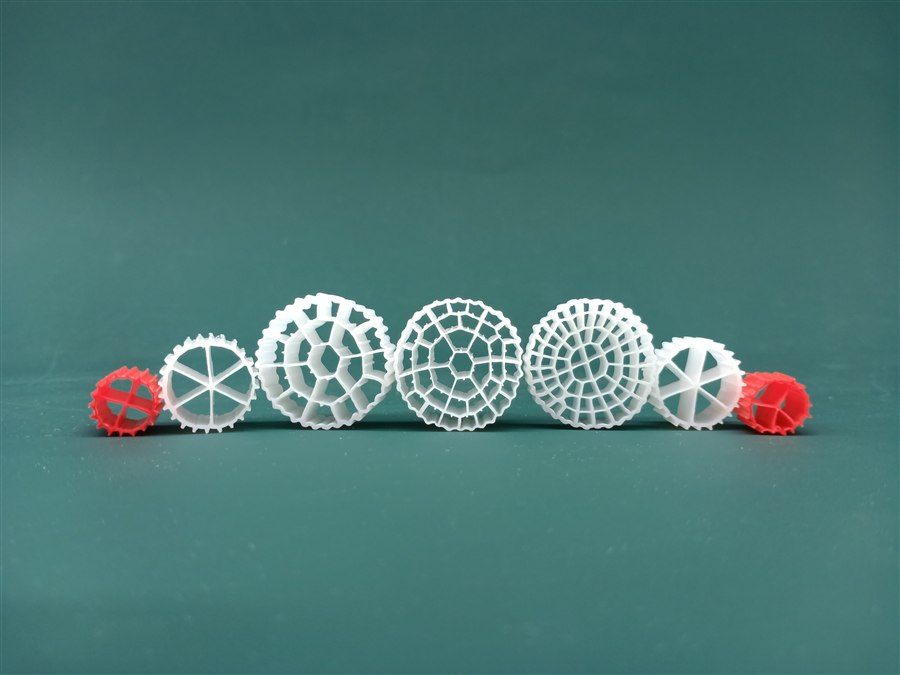
Two carriers can both be described as Φ25 mm and both claim high surface area, yet have different hole counts, wall thicknesses and manufacturing tolerances. Compare K1 with K5, or PE05 with PE06, and you can see why size alone does not define cost — or performance.
Recycled HDPE is widely used and lowers the price. Over a design life quoted at more than 15 years, it can also change mechanical durability. It is worth asking explicitly which one a quotation is based on.
Price per m³ falls with volume, but the step is not linear. Asking for pricing at two or three volume points is far more useful than asking for "the price".
Carrier is bulky and light — roughly 125 kg/m³ for K5, and less for the larger models. At many order sizes you are paying for container space rather than weight, and the destination port changes the number materially. Freight is often a significant share of landed cost and stays invisible in a headline quote.
Dosing sits between 15% and 67% of reactor volume. If you are budgeting per m³ of reactor rather than per m³ of carrier, the filling percentage multiplies everything — and it follows from your load, not from a rule of thumb.
Third-party test reports, material certificates or project-specific documentation are a line item. If your project requires them, say so at the enquiry stage rather than after the price is agreed.
Most "your price is higher" conversations turn out to be two suppliers quoting different things. Send these four and the numbers become comparable.
| 1. Reactor volume and configuration | In m³, plus whether it is a new build or a retrofit into an existing aeration tank. |
| 2. Required surface area or the design load | Either the carrier surface area specified, or the BOD / COD / ammonia load to be removed. One or the other — both is better. |
| 3. Destination port | Freight is a real share of landed cost for a bulky, light product, and it differs significantly by destination. |
| 4. Documentation and packing requirements | Whether test reports or certificates are needed, and whether the carrier must be supplied in a particular export packing. |
With those four, two suppliers are quoting the same scope. Without them, you are comparing a carrier price against a delivered price, or virgin polymer against recycled, and the comparison is meaningless.
We do not publish one, because the variables above change the number enough that a list would mislead more than help. Send the four points and you will get a firm project figure.
Not necessarily. A carrier with lower surface area needs more volume to do the same job, so the effective cost per unit of treatment capacity can be higher. Compare on surface area and dosing rate, not on the headline rate per m³.
MOQ is confirmed per order along with specification and destination — it is not fixed across models.
Yes. Tube settler media, disc aerators and filter media are all quoted against a confirmed specification, a quantity and a destination, for the same reason.
Payment terms are confirmed with the quotation and depend on the order and the relationship. They are not published here as they are not fixed.
We aim to respond within 24 hours on working days, provided the four points above are included. Enquiries missing them take longer because we have to come back and ask.
Send your water quality, treatment scale and target standard - we will confirm the right media, quantity and export packing.
Request a QuoteNo obligation - response within 24h (working days)