The difference is attached growth versus suspended growth — and that single difference decides footprint, load resilience, settling requirements and whether you can upgrade an existing tank without new civil works.

Everything else follows from this one distinction. It is not a question of which process is better in the abstract — it is a question of which one fits your load, your tank and your operators.
The biomass lives as floc suspended in the aeration tank, and the process depends on a secondary clarifier to separate that floc from the treated water and return it. The biomass inventory is limited by how much floc the clarifier can handle.
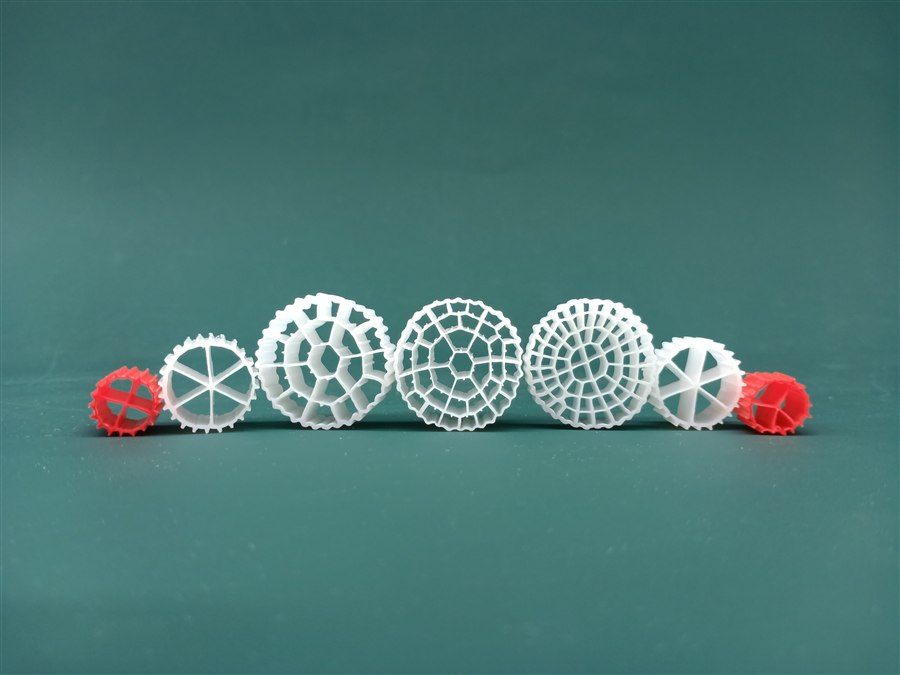
The biomass grows as biofilm on small carriers that circulate in the tank, kept moving by the aeration. Because the biofilm stays on the carrier, the process does not depend on sludge settling to hold its biomass — that is the key practical difference.
Biofilm on carriers packs far more active biomass into each cubic metre than suspended floc can. That is why a MBBR can often achieve the same duty in a smaller reactor volume, or add capacity to a tank that is already built.
| Biomass retention | MBBR: retained on carriers, independent of settling. AS: depends on clarifier performance and sludge settleability. |
| Footprint for the same load | MBBR generally smaller, because more active biomass fits per m³ of reactor. |
| Load shock resilience | MBBR is typically more forgiving — biofilm holds biomass through a shock that would wash floc out of a clarifier. |
| Secondary clarifier | AS requires one and its performance caps the process. MBBR reduces the dependence on clarification for biomass retention. |
| Retrofit into an existing tank | MBBR is well suited: carriers are added to the existing aeration tank, subject to the air system being able to fluidise the bed. |
| Operator intensity | AS depends on sludge age, return rates and settleability control. MBBR removes some of that, but adds carrier retention and screen checks. |
| Consumable | MBBR needs carrier media — our published service life is over 15 years for the HDPE grades, so it is closer to a capital item than a consumable. AS has no equivalent media cost. |
| Sludge production | Both produce waste sludge, but the biofilm system's sludge character and yield differ. Confirm with your process designer for your duty. |
You are upgrading an existing aeration tank and cannot add volume; the load is variable or carries a shock component; the existing clarifier is the bottleneck; or the site has no room for new civil works.
You are building new with adequate land; the load is steady and well characterised; you have skilled operators and reliable clarifiers; and you want to avoid the cost of carrier media entirely.
Many upgrades keep the existing activated sludge tank and add carriers to part of it — an A²O + MBBR configuration, for example. This raises the biomass inventory using plant you already own, and is the most common retrofit we supply media for.
A MBBR bed has to fluidise. If the existing aeration cannot move the carriers across the whole tank, adding media will not deliver the expected capacity. Check the air system before committing to a carrier volume.
This is the most common reason clients contact us. The sequence is broadly the same each time.
| 1. Establish the load | Influent and target effluent for BOD, COD and ammonia, plus design and peak flow. |
| 2. Check the tank can fluidise | Aeration capacity and diffuser layout determine whether carriers will move properly across the whole volume. |
| 3. Choose the carrier | Our K1–K5 and PE01–PE08 range runs from >600 to >1,300 m²/m³. Higher surface area suits clean, well-screened duty; larger internal channels suit higher solids. See the specification guide. |
| 4. Set the dosing rate | Our published range is 15–67% of reactor volume, derived from the load to be removed and the carrier surface area — not a rule of thumb. |
| 5. Add carrier retention | An outlet screen is required, and it becomes an ongoing maintenance item. |
| 6. Plan the ramp | Published film formation is 3–15 days; full nitrification acclimatisation takes longer, so plan a gradual ramp rather than an immediate step to design load. |
No. It carries a media cost and adds carrier retention as a maintenance item. It wins where footprint is constrained, load is variable, or clarification is the bottleneck — which is a large share of upgrades, but not all projects.
Yes — you still need solids separation downstream. What changes is that the biological process no longer depends on clarifier performance to hold its biomass, which is why the clarifier stops being the capacity cap.
It follows from the load and the carrier you choose, and it has to land inside the 15–67% dosing window. Send us the reactor volume, influent and target effluent and we will return a checked figure.
Yes. Our published K1–K5 nitrification rate is 400–1,200 gN/m³·d, with BOD oxidation at 2,000–10,000 g/m³·d. Design toward the middle of the range rather than the top, because those figures assume an acclimatised biofilm.
Over 15 years for the HDPE grades we publish, at a specific gravity of 0.96 for K1–K5 and 0.94–0.97 for the PE series.
Yes — hybrid configurations are common and are often the most practical upgrade. The carrier volume and the suspended-growth volume are then designed together against the same load.
Send your water quality, treatment scale and target standard - we will confirm the right media, quantity and export packing.
Request a QuoteNo obligation - response within 24h (working days)