Work out how much biofilm carrier you need from the pollutant load, and check the result against the 15–67% dosing window. The arithmetic runs in your browser — nothing is sent anywhere.

Run this once for each parameter your permit limits — BOD, COD and ammonia — and take the largest carrier volume. They do not peak in the same proportion.
| use peak flow | |
| BOD 2000–10000 · NH₃-N 400–1200 | |
| for the dosing check |
On the rate: published figures assume an acclimatised biofilm at favourable temperature. Designing at the top of the range leaves no margin for winter or load shock — mid-range is the safer design point.
| Step 1 — load | Flow × concentration removed. Concentration removed is influent minus target, not the influent figure. Work in grams per day: 1,000 m³/d × 270 g/m³ = 270,000 g/d. |
| Step 2 — volume | Carrier volume = load ÷ design rate. 270,000 ÷ 4,000 = 67.5 m³ of carrier. |
| Step 3 — dosing check | Carrier volume ÷ reactor volume must land between 15% and 67%. 67.5 ÷ 300 = 22.5%. |
| Step 4 — take the largest | Repeat for every limited parameter and use the biggest carrier volume. In our worked example nitrification alone would have given 58.3 m³ — about 14% short. |
The reactor is too small for the load at that carrier specification. Either the reactor needs to be larger, or you need a higher-surface-area carrier — our PE03 and PE08 reach over 1,000 and over 1,300 m²/m³.
The reactor is oversized for the carrier volume. Not a treatment problem, but a poor use of capital — and in a retrofit it usually means the tank can take more load than the original design assumed.
A calculated carrier volume is only deliverable if the aeration can fluidise it across the whole tank. On a retrofit this is the check that most often invalidates an otherwise correct calculation.
No. It runs entirely in your browser. Nothing you type is transmitted, stored or logged — you can disconnect from the network and it still works.
Use the published figure for the parameter you are calculating: BOD oxidation 2,000–10,000 g/m³·d, COD oxidation 2,000–15,000 g/m³·d, nitrification 400–1,200 gN/m³·d. Design mid-range rather than at the top.
Carrier volume quoted as a percentage of reactor volume is an output of the load calculation, not an input. The 15–67% window is our published suggested dosing range — outside it, either the reactor or the carrier choice needs revisiting.
If you are working from surface area rather than from a rate, yes. Our range spans over 600 to over 1,300 m²/m³, so a higher-surface-area carrier needs less volume for the same load. See the specification guide.
Yes. Send the design and peak flow, influent and target effluent for each limited parameter, the reactor volume and configuration, and whether it is new build or retrofit. We will return a checked carrier volume and model recommendation.
Yes — the tube settler media calculator sizes inclined media from hydraulic flow, which is a different calculation from the load-based method used here.
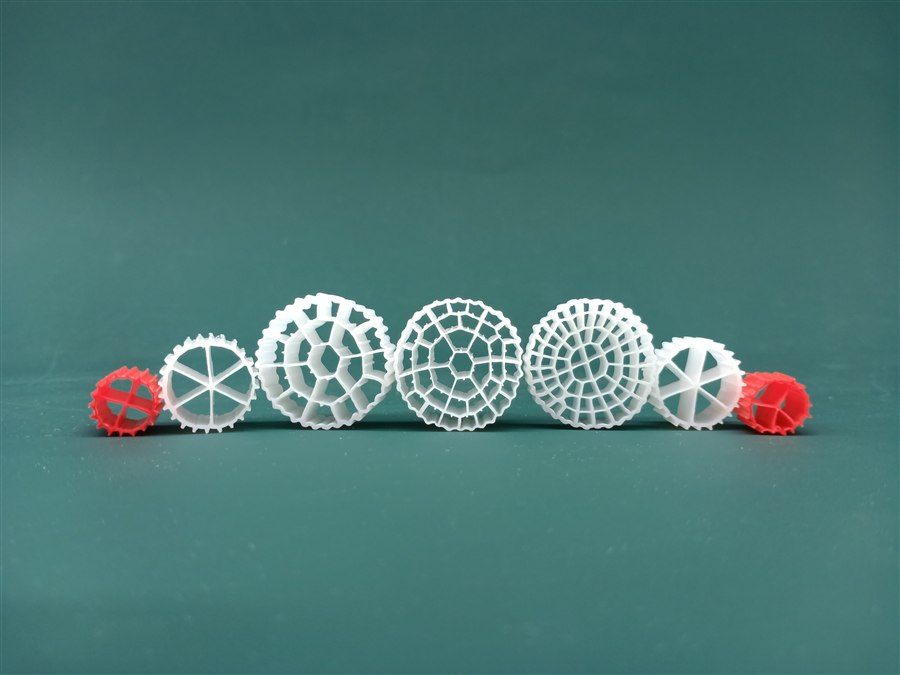
Send us the flow, influent and target effluent for each limited parameter, and the reactor volume - we will return a checked carrier volume.
Request a QuoteNo obligation - response within 24h (working days)