How to calculate MBBR carrier volume from your load — the three inputs you need, the formula that connects them, and a full worked example using our published rate figures.

MBBR sizing is not a r
Prefer to run the numbers yourself? Use the online MBBR media calculator.
ule of thumb and it is not a percentage of tank volume. It starts from the pollutant load you have to remove and the rate at which the carrier removes it.Design flow multiplied by the concentration you need to take out. Not the influent concentration — the difference between influent and target effluent. Work in grams per day.
The carrier's published removal rate: 400–1200 gN/m³·d for nitrification, 2000–10000 g/m³·d for BOD and 2000–15000 g/m³·d for COD, per m³ of carrier.
You need this to check the result against the dosing window. The calculation gives you carrier volume; the reactor tells you whether that is a sensible filling ratio.
Carrier volume (m³) = Load to remove (g/d) ÷ Design rate (g/m³·d). Then check: carrier volume ÷ reactor volume must land between 15% and 67%.
Take a plant with a design flow of 1,000 m³/d, an ammonia target and a BOD target. We calculate both and the larger governs.
| Design flow | 1,000 m³/d |
| Ammonia: influent → target | 40 mg/L → 5 mg/L, so 35 mg/L to remove |
| BOD: influent → target | 300 mg/L → 30 mg/L, so 270 mg/L to remove |
| Reactor volume | 300 m³ |
| Step 1 — ammonia load | 1,000 m³/d × 35 g/m³ = 35,000 gN/d |
| Step 2 — rate to design at | Published nitrification is 400–1200 gN/m³·d. The figures assume an acclimatised biofilm, so design mid-range: 600 gN/m³·d |
| Step 3 — carrier volume for nitrification | 35,000 ÷ 600 = 58.3 m³ of carrier |
| Step 4 — BOD load | 1,000 m³/d × 270 g/m³ = 270,000 g/d |
| Step 5 — BOD rate to design at | Published BOD oxidation is 2000–10000 g/m³·d. Design at 4000 g/m³·d |
| Step 6 — carrier volume for BOD | 270,000 ÷ 4000 = 67.5 m³ of carrier |
| Step 7 — take the larger | 67.5 m³ > 58.3 m³, so BOD governs and 67.5 m³ is the carrier volume |
| Step 8 — check the dosing window | 67.5 ÷ 300 = 22.5% of reactor volume — inside the published 15–67% range |
Result: quote 67.5 m³ of carrier for a 300 m³ reactor. Note that the nitrification calculation alone would have under-sized the bed by about 14% — which is why you always calculate each governing parameter and take the largest, not the first one you happen to compute.
The reactor is too small for the load at that carrier specification. Either the reactor needs to be larger, or you need a carrier with higher surface area per m³ — our PE03 and PE08 reach over 1,000 and over 1,300 m²/m³ respectively.
The reactor is oversized for the carrier volume, which is not a problem for treatment but is a poor use of capital. In a retrofit it usually means you can take on more load than the original design.
Two carriers at the same volume can differ substantially in surface area — PE05 and PE06 are both Φ25×10 mm with the same piece count, but one gives over 800 m²/m³ and the other over 600. If your calculation is based on surface area, the carrier choice changes the volume you need.
A calculated carrier volume is only deliverable if the aeration can move the bed across the whole tank. This is the check that most often invalidates an otherwise correct calculation on a retrofit.
The load figure is what you have to take out. Using the full influent concentration over-sizes the bed and the quote.
400–1200 gN/m³·d does not mean design at 1200. Those rates assume a fully acclimatised biofilm at favourable temperature; designing at the top leaves no margin for winter or load shock.
BOD, COD and ammonia rarely peak in the same proportion. Calculate each governing parameter and take the largest — as in the worked example above.
Design flow for the calculation should be peak hydraulic flow. Sizing on daily average is the classic reason a plant passes commissioning and then fails under real load.
People often quote a percentage of reactor volume, but that inverts the calculation — the percentage is an output, not an input. Two plants with the same reactor volume but different loads need different carrier volumes, and the same 15–67% window can cover both.
Calculate all the parameters your permit limits and take the largest carrier volume. In the worked example BOD governed, but in a plant with a tight ammonia limit and low organic load, nitrification can govern instead.
Yes, if you are working from surface area rather than from a rate. Our K1–K5 and PE01–PE08 range spans over 600 to over 1,300 m²/m³, so a higher-surface-area carrier needs less volume for the same load.
Carrier is quoted in m³, so you already have the number. What you also need is the model, the packing arrangement and the destination port — see the price factors guide for why those change the quotation.
Yes — m³ of carrier is the purchase unit. Allow for cutting losses and for the retained volume behind screens when you convert to a purchase quantity.
Yes. Send us the design and peak flow, influent and target effluent for BOD, COD and ammonia, the reactor volume and configuration, and whether it is a new build or a retrofit. We will return a checked carrier volume and model recommendation.
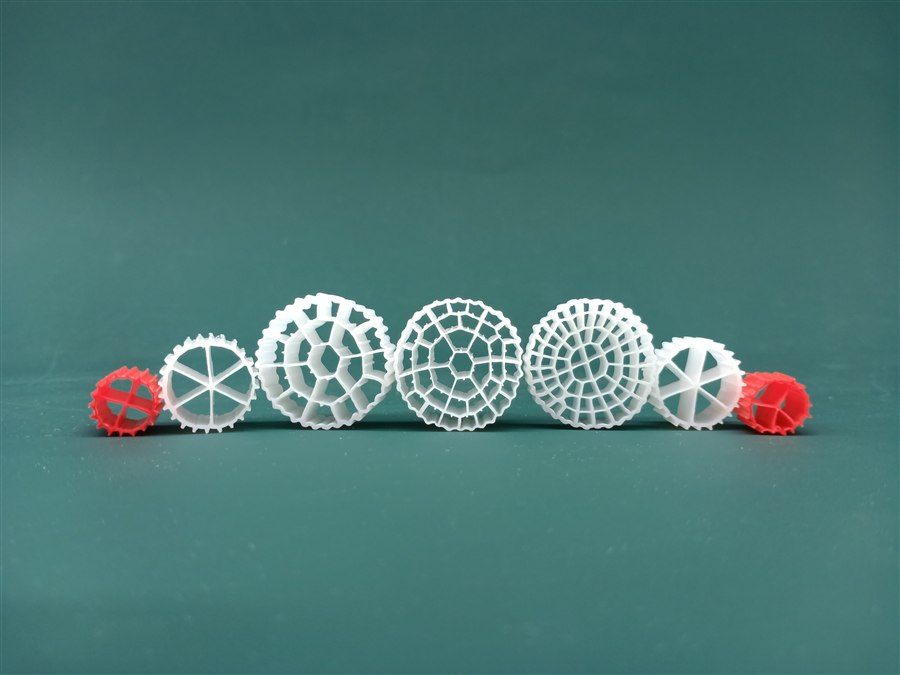
Give us the design and peak flow, influent and target effluent, and the reactor volume - we will return a checked carrier volume and model recommendation.
Request a QuoteNo obligation - response within 24h (working days)