Get a Quote
← All Products
Home / Products / Wastewater discharge standards
Compliance guide

Wastewater Discharge
Standards

A discharge standard sets the target. It does not tell you which process or which media gets you there. This guide maps the parameters standards regulate to the treatment stages and media that address them — and points you to the authority that actually publishes the limits.

ParametersAuthoritiesProcess mapping
Water treatment media for plants meeting discharge standards
Biological
BOD / COD
Solids
TSS
Nutrients
N / P
Settling boost
3 – 5×
Nitrification
400 – 1200 gN/m³·d
The target

A standard is a number. It is not a design.

Every discharge permit states limits for a set of parameters. Getting from those limits to a working plant is the design task — and it is where most under-performing upgrades go wrong, because the media gets chosen before the parameter list is mapped.

01

Limits are set locally, not globally

There is no international wastewater discharge standard. Each country — and in some federations each state or region — sets its own, and they change. Vietnam, for example, replaced eleven separate industrial wastewater standards with a single one effective 1 September 2025.

02

Limits differ by receiving water

The same effluent may face different limits depending on whether it discharges to a sewer, a river, a lake or the sea. Always confirm which category your permit falls under before specifying anything.

03

Existing plant may sit on a transition period

When a standard is replaced, plants already operating are often given a transition period on the old limits. Vietnam's 2025 industrial standard, for instance, allows facilities already in operation or already through environmental assessment to keep the previous standards until the end of 2031. That creates a long, predictable retrofit queue.

The parameters

What standards regulate, and what each one drives

Almost every discharge standard regulates these families of parameter. Each one points at a different part of the treatment train.

BOD / CODOrganic load. Drives the biological stage — reactor volume, biomass inventory and therefore MBBR carrier volume or aeration capacity.
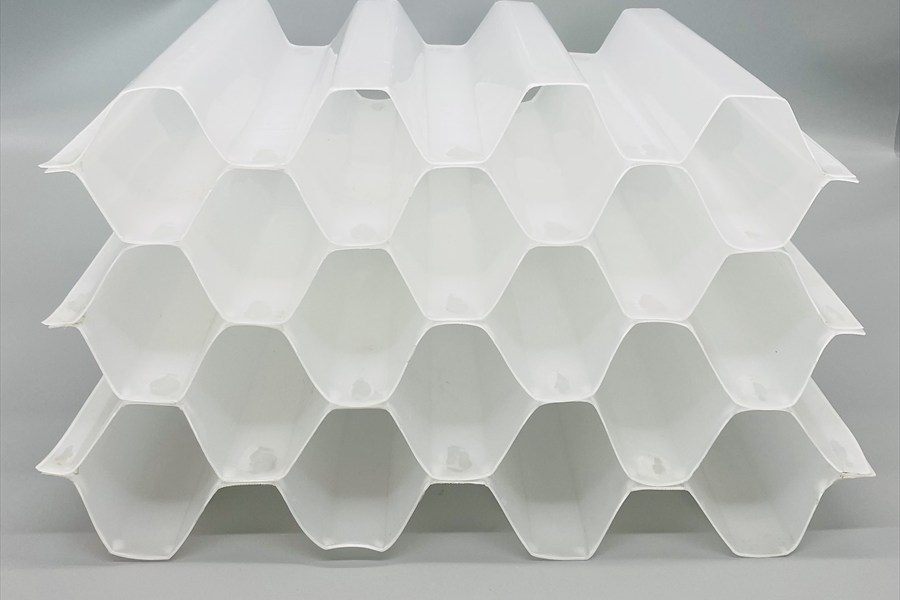
TSS / settleable solidsSuspended solids. Drives clarification (inclined tube or lamella media) and, for tighter limits, tertiary filtration.
Ammonia / total nitrogenDrives nitrification — aeration capacity and biofilm surface area. This is usually the parameter that forces an upgrade rather than maintenance.
Total phosphorusUsually chemical dosing plus biological uptake, with the solids then removed in clarification.
Oil and greaseDrives pre-treatment separation — and it decides your diffuser membrane material, because oil degrades EPDM.
pH and heavy metalsChemical pre-treatment and material selection. Aggressive chemistry decides whether PP, FRP or stainless steel is appropriate.
Coliform / disinfectionDownstream of the media stages; not a media selection driver, but it affects the overall train layout.
Where to check

Which authority publishes the limits

This table tells you where to look. It deliberately does not quote any limit values — those change, they differ by discharge category, and only the current official source is authoritative for your permit.

IndiaCPCB (Central Pollution Control Board) sets the general standards under the Environment (Protection) Rules, with State Pollution Control Boards (SPCBs) applying and enforcing them. Consents are issued at state level.
United KingdomEnvironment Agency (and the devolved regulators). Limits are set in the environmental permit for your site — standard rules permits or a bespoke permit.
PhilippinesDENR-EMB. The governing instrument is DAO 2016-08 — Water Quality Guidelines and General Effluent Standards of 2016 — alongside discharge permits.
SingaporePUB for discharge to sewers, under the Code of Practice on Sewerage and Sanitary Works; NEA for trade effluent to watercourses.
VietnamMinistry of Agriculture and Environment (formerly the Ministry of Natural Resources and Environment). Industrial wastewater limits are set by QCVN 40:2025/BTNMT, effective 1 September 2025, with a transition to the end of 2031 for qualifying existing facilities.
AustraliaState-based — there is no single national standard. Check the EPA of the relevant state or territory (for example NSW EPA or EPA Victoria) and the conditions of the site licence.
New ZealandRegional councils, through resource consents issued under the Resource Management Act 1991. Limits are site-specific conditions of consent.
Sri LankaCentral Environment Authority (CEA), under the National Environmental Act — schedule of effluent standards plus site licensing.

Whatever market you are in, the working rule is the same: design to the permit you will actually be held to, not to a remembered number from a different jurisdiction.

Mapping

From permit limit to media specification

This is the step that turns a compliance obligation into a purchase order. Work in this order.

01

Read the permit, not the standard

Your permit states which parameters apply to your discharge. Standards documents contain many parameters that will never apply to your plant. Take the permit's list as the requirement.

02

Find the gap, parameter by parameter

Compare current effluent against each limit. The parameters that fail define the problem — and different failures need different stages. A TSS failure is not a biological problem; an ammonia failure usually is.

03

Pick the stage before the product

Clarification failure → inclined media (see tube settler vs lamella). Biological capacity failure → MBBR carrier (see MBBR vs activated sludge). Oxygen transfer failure → diffuser upgrade. Only then does diameter or pore size come into it.

04

Size on peak, and on load

Clarifiers are sized on peak hydraulic flow and surface loading rate; biological stages on the pollutant load to be removed. Sizing either on daily average is the most common cause of a plant that passes commissioning and fails later.

05

Confirm materials against the chemistry

Aggressive or oily effluent decides whether PP, FRP or stainless steel is appropriate for inclined media, and whether the diffuser membrane should be EPDM or silicone.

06

Plan for the next tightening

Standards get tighter, not looser. A specification with some headroom costs little more at order stage and delays the next upgrade.

Common questions

Discharge standard questions

Q1

Do your products have to be certified to a discharge standard?

No — a discharge standard regulates the water leaving your plant, not the equipment inside it. It does not impose a product certification requirement. What it does is create the performance requirement that the media has to deliver.

Q2

Can you tell me the limit for my country?

We deliberately do not publish limit values, because they change, they differ by discharge category, and quoting a remembered number for your project would be irresponsible. We will instead work from the limits in your permit — send us the parameter list and target values and we will specify against it.

Q3

My standard just changed. What do I do first?

Check whether your facility qualifies for a transition period — many revised standards allow existing plants to remain on the previous limits for a defined period. Vietnam's 2025 industrial standard, for example, runs to the end of 2031 for qualifying facilities. That window is when retrofits get planned.

Q4

Which parameter usually forces an upgrade?

In our experience it is most often ammonia or total nitrogen. Organic load can frequently be handled by better operation of existing plant, but nitrification is capacity-limited: it needs aeration and biofilm surface area, which means new or additional media.

Q5

Can I meet a tighter TSS limit without new civil works?

Usually yes — inclined media in an existing clarifier raises the effective settling area within the same footprint, which is the cheapest route. If the limit is very tight you may also need tertiary filtration.

Q6

What should I send you?

The permit's parameter list with target values, current effluent analysis, design and peak flow, tank or reactor dimensions, and the destination port. With those we can specify media against your actual obligation rather than a generic product.
Related

Continue from here

Send us your permit limits

Give us the parameters and target values from your discharge permit, plus your flow and tank dimensions, and we will specify against your actual obligation.

Request a QuoteNo obligation - response within 24h (working days)