Get a Quote
← MBBR Media
Home / Guides / What is MBBR
Process explained

What is
MBBR?

MBBR stands for Moving Bed Biofilm Reactor — a biological wastewater treatment process where the bacteria grow as biofilm on small plastic carriers that circulate freely in the aeration tank.

Moving Bed Biofilm ReactorAttached growthCarriers in suspension
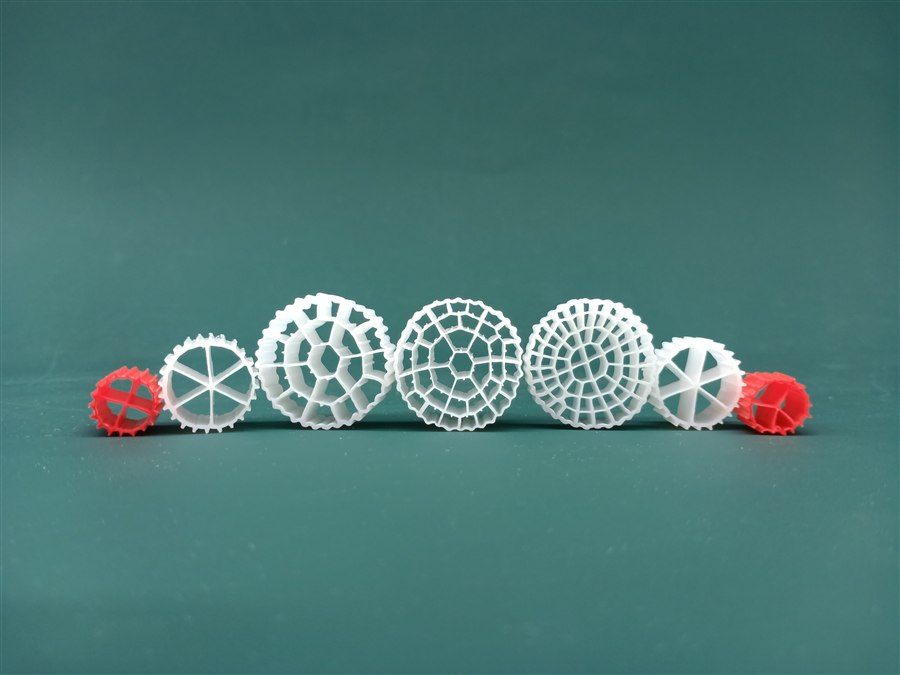
MBBR moving bed biofilm reactor carrier media
Stands for
Moving Bed Biofilm Reactor
Growth type
Attached biofilm
Carrier surface
>600 – 1300 m²/m³
Dosing rate
15 – 67%
Carrier life
>15 years
The idea in one paragraph

Bacteria on carriers that move

Take a conventional aeration tank, fill part of it with small plastic shapes, and keep those shapes moving with the air you were already blowing. The bacteria attach to them instead of forming suspended floc. That is the whole process.

01

Moving bed

The carriers are not fixed in place and they are not a packed bed. They circulate continuously through the tank volume, driven by the aeration. This is the "moving bed" part of the name, and it is what keeps the whole biofilm surface in contact with the wastewater.

02

Biofilm reactor

The bacteria grow as a biofilm on the carrier surfaces rather than as suspended floc. The reactor is therefore a biofilm reactor — the treatment capacity comes from the surface area the carriers provide, not from a suspended sludge inventory.

03

Why the carriers move at all

Movement is not a design preference. A static bed of carriers would clog and channel. Continuous circulation keeps every surface exposed to substrate and oxygen, and it shears off excess biofilm so the layer stays thin and active.

How it works

The four elements of an MBBR

1. Carrier mediaSmall plastic shapes — typically HDPE — with a protected internal surface for biofilm and an external shape that lets them move freely. Our K1–K5 and PE01–PE08 range spans over 600 to over 1,300 m²/m³ of surface area.
2. AerationDoes two jobs at once: supplies oxygen to the biofilm, and keeps the carriers in suspension. If the air cannot move the bed, the process does not work — which is why a retrofit always starts with an aeration check.
3. Retention screenKeeps the carriers inside the reactor while letting treated water out. It is a simple component but it is a permanent maintenance item.
4. Solids separationDownstream clarification, exactly as in any biological process. What changes with MBBR is that the biological stage no longer depends on clarification to hold its biomass.
What the carrier provides

Surface area is the treatment capacity

Because the bacteria live on the carriers, the carrier's surface area per m³ sets how much treatment capacity fits in your tank. These are our published figures.

Surface area>600 – 1,300 m²/m³ depending on model
Density0.96 for K1–K5; 0.94–0.97 for the PE series — close enough to water to fluidise at reasonable air rates
Porosity>85% (K1–K2) / >90% (K3–K5)
Dosing rate15 – 67% of reactor volume
Film formation3 – 15 days
Nitrification rate400 – 1,200 gN/m³·d
BOD oxidation2,000 – 10,000 g/m³·d
Operating temperature5 – 60 °C
Service life>15 years
Where it is used

Typical MBBR applications

01

Upgrading existing plants

The most common use. Carriers go into an aeration tank that already exists, raising the biomass inventory without new civil works — an A²O + MBBR configuration, for example. See the MBBR vs activated sludge comparison.

02

Nitrification duty

Nitrification needs surface area and oxygen. Because MBBR supplies both independently of sludge age, it is often the answer when an ammonia limit is what the plant fails on.

03

Industrial effluent with variable load

Biofilm holds its biomass through load shocks that would wash floc out of a clarifier, which suits plants whose influent varies.

04

Space-constrained sites

More active biomass per m³ means a smaller reactor for the same load — useful where land is limited or the tank is fixed.

Specifying

What you need to decide

Carrier modelSet by solids loading and reactor configuration — smaller carriers give more surface but smaller channels. See the specification guide.
Carrier volumeCalculated from the load to be removed, then checked against the 15–67% dosing window. See the calculation guide.
Aeration capacityMust be able to fluidise the bed across the whole tank — the constraint that most often decides whether a retrofit is feasible.
Retention screenSized so carriers cannot escape and the screen does not blind.
Downstream clarificationUnchanged in principle, but no longer the limit on biological capacity.
Common questions

MBBR questions

Q1

What does MBBR stand for?

Moving Bed Biofilm Reactor. "Moving bed" because the carriers circulate in suspension; "biofilm reactor" because the bacteria grow as attached biofilm on the carriers rather than as suspended floc.

Q2

Is MBBR aerobic or anaerobic?

The classic MBBR is an aerobic process — the aeration supplies oxygen and moves the bed. The carrier technology is also used in anoxic and anaerobic configurations, where mixing rather than aeration keeps the bed moving.

Q3

What is MBBR media made of?

The grades we publish are HDPE — high-density polyethylene — at a specific gravity of 0.96 for K1–K5 and 0.94–0.97 for the PE series, with a published service life of over 15 years.

Q4

How is MBBR different from a trickling filter?

Both are attached-growth processes, but the carrier is different. A trickling filter has a static bed with wastewater flowing over it and air passing through. A moving bed keeps the biofilm carriers in continuous suspension in the bulk liquid, which gives far better contact and no clogging of a static bed.

Q5

How much carrier do I need?

It is calculated from the pollutant load and the carrier's removal rate, then checked against the 15–67% dosing window — see the calculation guide for a worked example.

Q6

Can MBBR be added to an existing activated sludge plant?

Yes — that is its most common use. The carriers are added to the existing aeration tank, subject to the air system being able to fluidise the bed. See the comparison guide for the retrofit sequence.
Related

Continue from here

Working on an MBBR project?

Send us the reactor volume, influent and target effluent - we will confirm the carrier model, volume and export packing.

Request a QuoteNo obligation - response within 24h (working days)