Two names that get used as if they were alternatives, when one is a biological process and the other is a separation process. Here is what actually differs, and how to decide for a real plant.

Almost every confused comparison of these two technologies comes down to this one sentence.
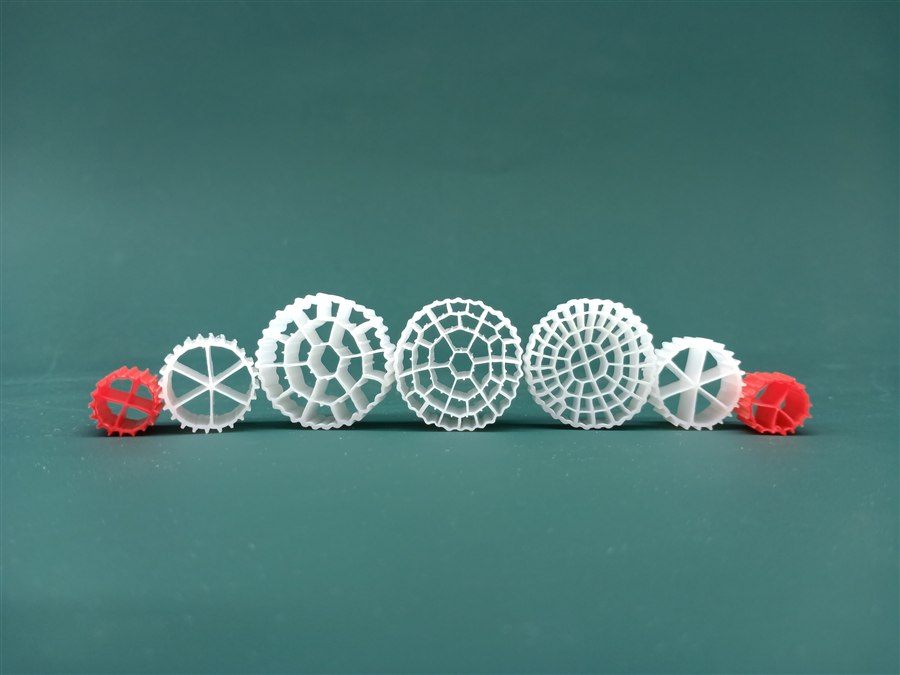
MBBR - moving bed biofilm reactor. Small plastic carriers move freely in the aerated tank while the biomass grows on their protected surface. The carriers raise the amount of biology you can hold in a given volume of concrete, which is what lets an existing tank take more load. But the carriers do not separate anything: the biomass still has to be settled out or filtered downstream, exactly as in a conventional activated sludge plant.
MBR - membrane bioreactor. The biology is conventional; what changes is the separation. A membrane, normally submerged, sits where the clarifier would be and holds back the solids, so the reactor can run at a much higher biomass concentration and the permeate comes out clear. The membrane is doing the job the clarifier used to do - and it is the membrane that dominates the energy and replacement cost.
Which is why the honest answer to "which is better" is: MBR wins on effluent quality and footprint, MBBR wins on capital and whole-life cost, and they are frequently used together.
Qualitative on purpose - every plant has different energy prices, discharge standards and site constraints, so numbers here would be misleading.
| Question | MBBR | MBR |
|---|---|---|
| What it is | Biofilm process - biomass on moving carriers | Separation process - membrane instead of clarifier |
| Effluent quality | Meets normal discharge standards with a well-run clarifier or filter | Low solids and bacteria; suitable for reuse and sensitive receiving water |
| Footprint | Compact reactor, but needs a clarifier or filter after it | Smaller total footprint - separation happens in the same tank |
| Energy | Process air only | Process air plus membrane scouring air and permeate pumping |
| Replacement cost | Carriers are long-lived; nothing consumable in normal service | Membranes are a scheduled replacement every few years |
| Operation | Simple - screens, aeration, sludge return | Needs membrane cleaning regimes, fouling control and more instrumentation |
| Best fit | Capacity upgrade on an existing tank; strong influent; tight budget | Reuse water, sensitive discharge, very tight site, high and stable quality |
| Common failure mode | Retention screen blocked or aeration short of the higher demand | Fouling and membrane life consumed faster than planned |
Write down what the permit actually requires for suspended solids and ammonia. If a well-run clarifier meets it, membrane quality is money spent on something nobody asked for.
If there is no room for a clarifier, the total-footprint advantage of the membrane usually decides the question before cost is even discussed.
Carriers only help if the tank has aeration capacity to feed the extra biomass and a clarifier that can handle the higher solids return. Those two checks kill more MBBR retrofits than anything else.
Membrane replacement, scouring energy and cleaning chemicals are the items that change the ranking over twenty years.
Carrier volume is calculated from the load you have to remove, then checked against the dosing window - not chosen from a table.
Divide the load to be removed by the design removal rate for that parameter, run it for each parameter (BOD, COD, ammonia) and take the largest answer. Then check the result against the 15-67% dosing window for the reactor volume. The worked example is in the MBBR media calculation guide, and the online calculator does the arithmetic.
If what you actually want is a comparison against conventional activated sludge rather than a membrane, that is a different page: MBBR vs activated sludge. And if you are still deciding what MBBR is, start with what is MBBR.
The questions that come up in every one of these conversations.
No, and the names are confused often enough to be worth stating plainly. MBBR is a biofilm process: plastic carriers move in the aerated tank and the biomass grows on them, with a conventional clarifier or filter downstream to separate the solids. MBR is a separation process: a membrane, usually submerged, replaces that clarifier. You can run an MBBR in front of a membrane - that combination is common - but the carriers are not a membrane.
MBR, comfortably. A membrane retains solids down to the micron range, so the permeate is low in suspended solids and typically low in bacteria, which is why MBR is specified where water is reused or discharged to a sensitive receiving water. MBBR with a well-run clarifier will meet normal municipal discharge standards, but it does not give you reuse-grade water on its own.
It depends on where you put the cost. An MBR pays for membrane replacement every few years and for the air scouring and permeate pumping that keep the membranes clean, on top of the process air. An MBBR pays for process air and for whatever separation stage follows it, and it has no membranes to replace. For a plant discharging to a normal standard, the MBBR route is usually the lower whole-life cost; where the discharge standard or a reuse requirement demands membrane-quality water, the membrane is not optional.
Yes - that is the most common reason people ask this question. The carriers go into the existing aerated tank, a retention screen goes at the outlet, and the extra biomass lets the same concrete treat more load or a stronger influent. The two things to check first are the aeration capacity (more biomass means more oxygen demand) and the clarifier's ability to handle the higher solids return.
It needs more total footprint, because it needs a clarifier or filter after the reactor. The reactor itself is compact - that is the point of the carriers - but an MBR wins on total footprint because separation happens inside the same tank. On a tight site, that difference usually decides the choice.
It is a real configuration, and it is how a lot of capacity upgrades are done: carriers in the existing aerated tank to raise the biological capacity, then a membrane instead of a clarifier to hold the solids and produce a high-quality permeate. You get the retrofit simplicity of the carriers and the effluent quality of the membrane, at the cost of both the membranes and the air that scours them.
Send the tank dimensions, the flow and the influent analysis - we will tell you what carrier volume the load needs, and whether the aeration you have can support it.
Ask for a specification checkNo obligation - response within 24h (working days)