On this page
Two jobs: transfer and mixing
Before comparing products, be clear which job you are buying. They are specified differently and one device rarely does both well.
- Oxygen transfer. Dissolving oxygen into mixed liquor so the biology can work. Efficiency is everything here, because aeration is usually the largest energy cost in a treatment plant.
- Mixing. Keeping solids in suspension, preventing deposition, or driving a circulation pattern. Efficiency is measured in jet momentum, not in oxygen.
Fine bubble membrane diffusers win the first. Coarse bubble devices — vortex, jet and barrel aerators — win the second. A plant that specifies a coarse bubble device for oxygen transfer, or a fine bubble membrane for mixing duty, will be disappointed in a way no amount of supplier support can fix.
The five formats we make
| Format | Our published range | Job it suits |
|---|---|---|
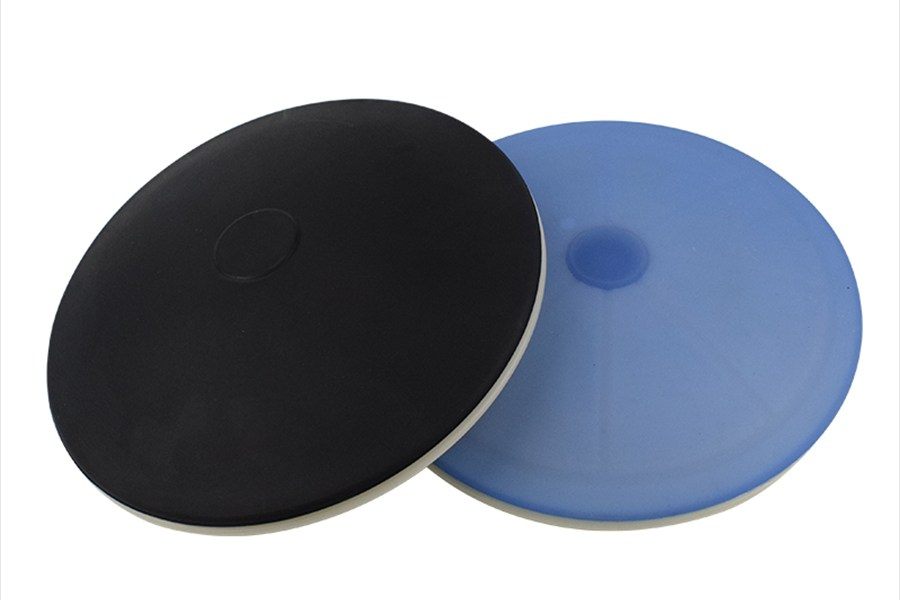
| Disc diffuser disc aerator | 215 / 260 / 300 mm diameter; EPDM or silicone membrane. Recommended combinations are 215 mm EPDM, 260 mm EPDM and 300 mm silicone | Oxygen transfer in aerobic tanks, aerated biofilters and aquaculture. Grid layouts in square or rectangular basins |
| Tube diffuser tube aerator | 69 mm outside diameter; 580 / 800 / 1000 mm lengths; EPDM micro-pore membrane, 1.5 mm pores on a 2 × 2.5 mm pitch with a 15 mm unperforated zone on top; bubble size 1–3 mm; oxygen utilisation 35–42% | Long channels, deep tanks, and retrofits where the air main already runs down one wall |
| Plate diffuser plate aerator | Flat-plate fine bubble membrane diffuser, low profile | Where headroom above the floor is tight, or the floor layout cannot take discs |
| Single-orifice membrane single orifice aerator | Single-orifice membrane diffuser for aerated biofilters | Biological aerated filters (BAF), where a single orifice per unit suits the shallow bed and the backwash regime |
| Vortex / jet aerator vortex aerator | Barrel and jet format, coarse bubble | Mixing, equalisation, anoxic zones, high-solids duty — anything where blocking resistance beats transfer efficiency |
If you are choosing specifically between the two most common formats, the dedicated comparison is disc diffuser vs tube diffuser, and the selection walk-through is aeration diffuser selection.
The four numbers that decide it
Four figures decide the format, in this order. Note that only one of them is a product property.
- Water depth. Sets the contact time between bubble and water, and therefore the transfer efficiency more strongly than any diffuser choice. A deeper tank with ordinary diffusers beats a shallow tank with premium ones.
- Airflow range, not the design point. The minimum airflow at which the membrane opens fully is the constraint at low load. Get this wrong and the membranes foul on the underside every night.
- Basin plan and headroom for removal. Decides disc against tube more often than performance does. A tube has to be lifted out as a unit; a disc is unbolted individually.
- Tank geometry and baffling. A well-baffled basin with an ordinary diffuser will out-perform a badly baffled one with premium diffusers. Check the baffling before blaming the diffusers.
Depth beats every other variable
Oxygen transfer efficiency rises steeply with water depth, because the bubbles have longer to give up their oxygen before they reach the surface. This single effect is larger than the difference between a disc and a tube, which is why we do not publish a single "efficiency" number intended to stand in for a full aeration design — and why you should be suspicious of anyone who does.
Our tube diffuser is published at 35–42% oxygen utilisation, and that figure is for the diffuser under reference conditions. In a real basin the number will move with depth, airflow, the mixed liquor concentration and the condition of the membrane. Treat it as a benchmark for comparing diffusers, not as a prediction for your plant.
Membranes: EPDM or silicone
The membrane is the part that wears, and the material choice is decided by the waste stream rather than by price.
- EPDM — the standard for municipal wastewater and most organic industrial streams. Tolerates normal chemistry and repeated flexing. Attacked by oils and solvents.
- Silicone — specified where the stream runs hot or carries solvents that attack EPDM, and it resists fouling better in some duties. Costs more and is not universally better.
Note our own recommended combinations: 215 mm and 260 mm discs in EPDM, 300 mm in silicone. That is a membrane-area-to-perforation trade-off rather than a claim that one elastomer is superior.
How to check an aeration quote
Five questions will separate a real calculation from a copied table.
- What is the minimum airflow at which the membrane opens? If the answer is "we do not specify that", the quote cannot be checked against your night-time load.
- What water depth was assumed? Efficiency figures without a depth are not comparable.
- How many units, and on what grid? A total airflow with no unit count cannot be verified against floor area.
- What is the headroom for removal? This decides whether the disc or tube answer was even available.
- What are the air main and branch sizes? Undersized piping turns an efficient diffuser into a poor one through pressure loss.
The unit conversions that make those checks possible — m³/h to cfm, kPa to metres of water column — are in the unit converter.
Failure modes and what they tell you
- Membrane fouled on the underside. Almost always too low an airflow: the membrane never opened fully, so the perforations sat tight against the support plate. Fix the turndown, not the diffuser.
- Uneven bubbling across one header. Piping or a partly closed valve, not the diffusers. Swap two units to confirm before ordering replacements.
- Media in the air main. A membrane has failed or a clamp has come off. This is the failure that damages the blower, which is why scheduled membrane replacement matters.
- Good dissolved oxygen, high blower pressure. Fouled membranes or blocked diffusers. Rising pressure at constant airflow is the clearest early indicator you have.
- Poor transfer despite new diffusers. Look at baffling, tank depth and airflow distribution. This is the most common outcome when a plant is re-diffusered to fix a mixing problem.
Questions buyers ask
What is the difference between fine bubble and coarse bubble aeration?
Fine bubble diffusers produce bubbles in the 1-3 mm range through a perforated elastic membrane, which gives a large transfer surface per unit of air and therefore a high oxygen transfer efficiency. Coarse bubble devices produce much larger bubbles with far lower transfer efficiency, but they are cheap, almost impossible to block, and excellent at mixing. Coarse bubble is usually chosen for mixing duty, fine bubble for oxygen transfer.
Which diffuser is more efficient, disc or tube?
At the same bubble size the transfer mechanism is identical, so field efficiency is dominated by tank depth, mixing and baffling rather than by the shape. The real difference is geometry: a disc covers a small footprint on a grid, a tube produces a line of bubbles. Choice follows the basin plan and the headroom available for removing a unit, not a transfer-efficiency number.
What oxygen utilisation should a tube diffuser achieve?
Our EPDM micro-pore tube diffuser is published at 35-42% oxygen utilisation under reference conditions. That is a figure for the diffuser itself, not a prediction for a plant: real transfer efficiency depends on water depth, airflow, mixing pattern and the condition of the membrane.
How do I know when to replace diffuser membranes?
The membrane is a wear item. Fouling, hardening and the growth of a biological film on the surface all reduce transfer efficiency gradually, so the honest indicator is rising blower pressure or falling dissolved oxygen at the same airflow. Plan replacement on a schedule rather than waiting for failure, because a failed membrane usually means media entering the air main.
Do I need a vortex aerator rather than a fine bubble diffuser?
If the requirement is mixing rather than oxygen transfer - equalisation tanks, anoxic zones, sludge holding, high-solids duties - a vortex or jet aerator is often the better tool because it moves water and resists blocking. Where the job is dissolving oxygen into mixed liquor, a fine bubble membrane diffuser wins on efficiency by a wide margin.