On this page
Why attached growth at all
Suspended activated sludge is a good process that fails in a predictable way: when the load rises, the biomass washes out of the clarifier faster than it grows. Attached growth changes that. The biofilm holds on to the surface, so the solids retention time is set by the carrier rather than by the clarifier, and slow-growing organisms — the nitrifiers in particular — can establish.
That is why carriers are the standard answer to two situations: an existing tank that has to take more load, and a plant that has to nitrify reliably at a temperature it was not designed for. See what is MBBR for the process view.
The three families of carrier
| Family | Behaviour | Where it belongs |
|---|---|---|
| Moving carriers | Fluidised by aeration, kept in the tank by a retention screen | Aerobic tanks. The default choice for a capacity upgrade |
| Fixed hanging media | Mounted on a frame, water flows past | Anoxic and anaerobic zones, low-energy plants, tanks that cannot take a screen |
| Fixed or stacked media | Installed as a bed or stack | Trickling filters, submerged aerated filters, polishing stages |
MBBR media: K1 to K5 and the PE series
Names you will see in a tender or a quoteMBBR media · MBBR carrier · moving bed biofilm carrier · moving bed biofilm media · biofilm carrier media · bio media · bio carrier · K1 media · K3 carrier · K5 carrier · PE01–PE08 carrier · suspended packing · porous suspended ball · spherical bio carrier · moving bed ball · bio ball
The moving bed biofilm reactor carrier is the workhorse. Our range runs K1 through K5 in HDPE, from Φ10 × 10 mm up to Φ25 × 5 mm, with the perforation count rising across the series — 4–5 holes on K1 through to 64 holes on K5 — and specific surface area from above 800 m²/m³ on the small types to above 1,000 on the high-surface variants.
| Property | Published value |
|---|---|
| Types | K1, K2, K3, K4, K5 (Φ10 × 10 to Φ25 × 5 mm) plus the PE01–PE08 series |
| Material and density | HDPE, density approximately 0.96 g/cm³; PE series 0.94–0.97 g/cm³ |
| Specific surface area | Above 800–1,000 m²/m³ for K types; above 600–1,300 m²/m³ across the PE series |
| Porosity | Above 85–90% |
| Packing density | From more than 76,000 up to 850,000 pieces per cubic metre depending on type |
| Biofilm formation | 3–15 days |
| Nitrification rate | 400–1,200 g N/m³·d |
| BOD / COD oxidation | 2,000–15,000 g/m³·d |
| Service temperature | 5–60 °C |
| Service life | Beyond 15 years |
The full column-by-column explanation of what each of those numbers changes is in MBBR media specification, and the product is MBBR moving bed media.
Ball and sphere carriers
Where the tank is shallow, the aeration is weak, or the duty wants a larger protected volume, ball formats take over.
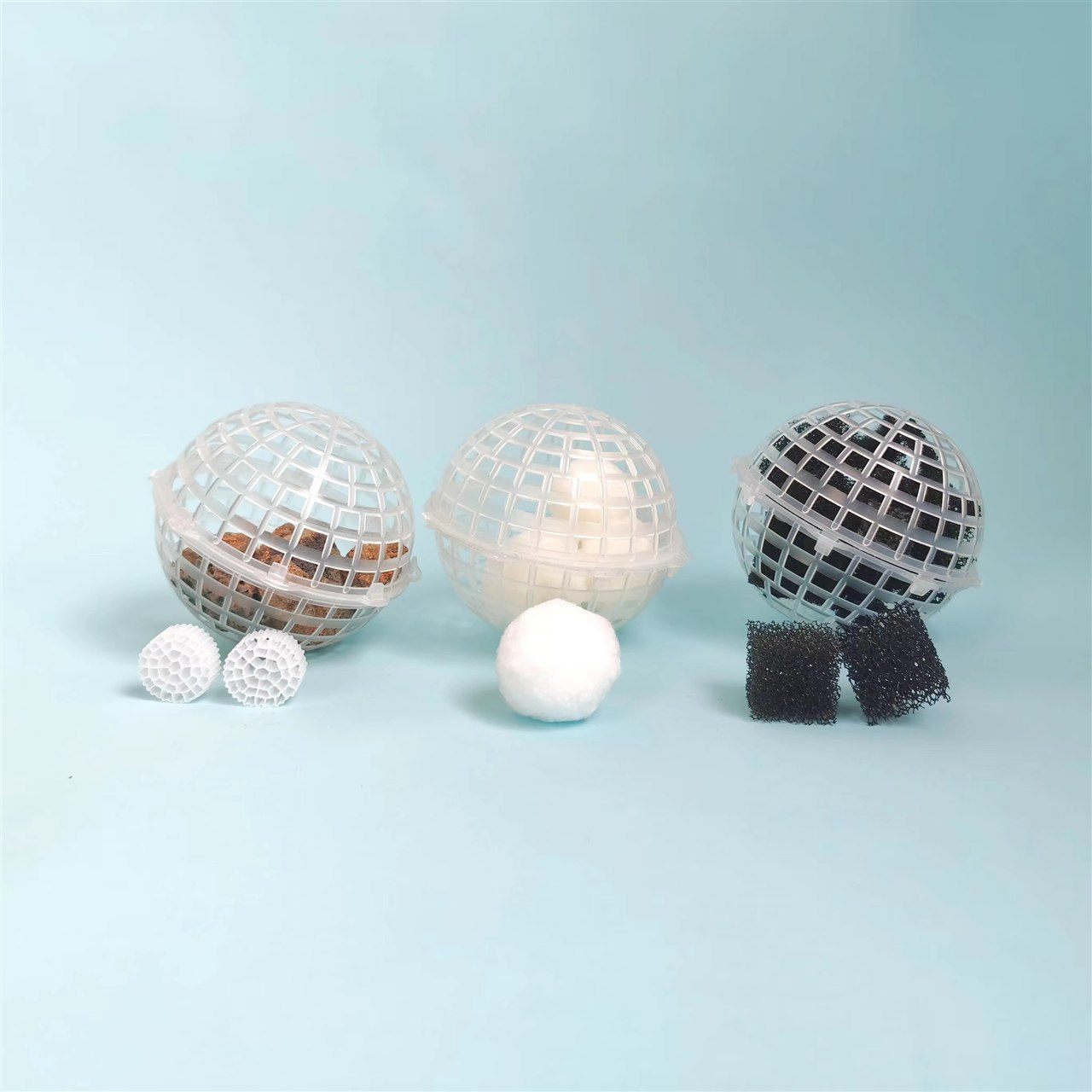
- Suspended ball media — hollow or porous spheres that fluidise like MBBR media but at a larger diameter. Also called bio balls or moving bed balls in the trade.
- Multi-faceted hollow ball — a polyhedral sphere with a large internal protected surface, used as tower packing and as a carrier where its geometry suits.
- PP liquid surface cover ball — a different job entirely: floating on the surface to cut evaporation, odour and heat loss. Do not confuse it with a bio carrier; it carries nothing.
- ABS flocculation ball — again a different job: generating micro-vortices in a flocculation stage to build floc, not to grow biofilm.
Sponge carriers
Polyurethane sponge media holds a very high biomass per unit volume because the internal structure is protected on all sides. It suits high-load duties where tank volume is fixed and the biology has to be concentrated. The trade-off is that a sponge carrier is harder to fluidise than a rigid one and needs adequate aeration to avoid compacting, and the internal volume can eventually clog with inert material in high-suspended-solids service.
Hanging media
Hanging media is fixed on a frame and does not depend on aeration to stay in place. That makes it the right answer in three situations: anoxic and anaerobic zones, plants with a tight energy budget, and retrofits where fitting a retention screen is impractical.
| Product | Character | Typical duty |
|---|---|---|
| Combined packing media | Semi-soft composite, also sold as contact oxidation packing | General aerobic and anoxic retrofits |
| Elastic packing | Wave-form elastic strands, high void ratio, resists compaction | Aerobic tanks with high solids, and duties where a fixed carrier must not blind |
| Biological rope media | Braided rope or belt on a frame | Long, narrow tanks and channels; low-energy installations |
| Carbon fibre water grass | Fine carbon fibre strands, very high surface area to volume | Anoxic and anaerobic zones, polishing, and ecological water bodies |
Hanging media cannot be replaced without draining the tank, and the frame has to be designed with the media rather than afterwards. Both of those are good reasons to specify generously the first time.
Fill fraction: the number that ties it together
Fill fraction — sometimes called dosing ratio — is the percentage of reactor volume occupied by carriers at rest. It is the single number that converts a biological requirement into an order quantity, and it is almost always specified wrong.
The method is three steps:
- Work out the load to be removed for each parameter — BOD, COD, ammonia.
- Divide each by the design removal rate for that parameter and take the largest carrier volume.
- Check that volume against the fill fraction window for your reactor.
The worked example, including the 15–67% window, is in MBBR media calculation. The MBBR media calculator runs the arithmetic and checks the window for you.
Choosing between them
- Is there aeration in the zone? If no, hanging media. If yes, continue.
- Is the tank deep enough to fluidise the carrier you want? Shallow tanks push you toward larger, lighter carriers or hanging media.
- What load has to be removed, and at what temperature? Run the calculation; the answer gives the carrier volume, not the carrier type.
- Can the existing aeration feed the extra biomass? More biology means more oxygen demand. If it cannot, the carriers will make dissolved oxygen worse.
- Can the clarifier return the extra solids? The second check that kills retrofits. Neither is about the carrier.
If the question behind the question is whether carriers will fix the plant at all, MBBR vs activated sludge is the honest comparison to read next.
Questions buyers ask
What is fill fraction in MBBR and why does it matter?
Fill fraction is the percentage of reactor volume occupied by carriers at rest. It matters because it is the bridge between the biology you need and the concrete you already have: too little and the reactor cannot remove the load, too much and the carriers cannot be kept moving, the screen blinds and the surface area you paid for is unreachable. It is an output of the load calculation, in the 15-67% window, not a figure to pick from a catalogue.
Are bio balls the same as MBBR media?
They are both attached-growth carriers, but they are different tools. MBBR media is small, has a high specific surface area, and is designed to fluidise freely in an aerated tank - which is why it is dosed by fill fraction. A suspended bio ball is larger, with a protected internal volume, and suits shallower tanks, weaker aeration, or duties where a bigger carrier will not wash out through the screen.
When should I use hanging media instead of moving carriers?
When there is no aeration to keep carriers in suspension - anoxic and anaerobic zones are the clear case - or when the plant has to run on minimal energy. Hanging media is also easier to justify in a tank that has to be emptied rarely, because it can be designed on a frame that lifts out. The trade-off is that it cannot be replaced without draining.
Can I mix two types of carrier in one reactor?
It is done, and sometimes deliberately, to create a range of protected surface sizes. But the sizing gets harder: specific surface area, fluidisation behaviour and the fill fraction all differ per type, so the calculation has to be run per type and then checked for the total that the aeration can actually keep moving. Mixing types without redoing the aeration check is how reactors end up with carriers in piles.
How long do MBBR carriers last?
Our HDPE carriers are published at a service life beyond 15 years. They are not a wear item in the way a diffuser membrane is: the carrier is not consumed, and provided it is kept fluidised and the screen is maintained, it will outlast most of the plant around it.