On this page
Every name, and what it actually means
Buyers search for this product under a dozen names, and suppliers use them interchangeably. That is fine as long as everyone means the same physical thing. This is the mapping.
| Name you will see | What it refers to |
|---|---|
| Tube settler media, tube settling media, tube deck media | The generic product: modules of small inclined tubes, installed as a bed in a clarifier |
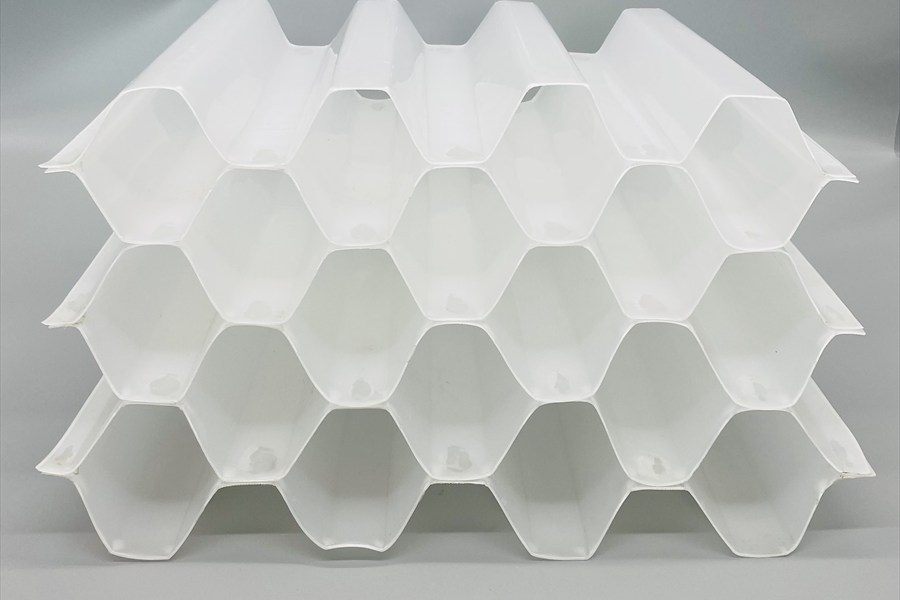
| Honeycomb tube settler, hexagonal tube settler | The same product described by its cross-section — hexagonal cells that share walls |
| Inclined tube settler, lamella tube settler | The same product described by its installation — inclined, and therefore a lamella in the classical sense |
| Lamella clarifier media, lamella plate pack | Usually the plate version, sometimes the tube version used loosely |
| Inclined plate media, inclined plate settler, tube settler plates | The flat-sheet geometry: parallel plates forming shallow cells |
| Clarifier media, settling media | Category words covering both |
| Stainless steel tube settler, SS lamella media, metal tube settler, stainless honeycomb tube settler | The same geometry in metal, for aggressive water or high temperature. Grade confirmed against the water analysis |
The principle: shorten the fall, not the tank
A conventional clarifier works by giving particles enough time to fall to the floor. Its capacity is therefore set by surface area: flow divided by area gives the rise rate, and any particle that settles faster than that rise rate is captured.
Settling media does not change the rise rate. What it changes is the distance a particle has to travel. Instead of falling several metres through the tank, it falls a few centimetres to the nearest inclined surface, slides down that surface, and joins the sludge. The result is that the same tank footprint behaves as though it had a far larger settling area — because, hydraulically, it does.
Our published figures for the tube range: pore sizes from Φ25 to Φ90 mm, modules of 1000 × 500 × 1000 mm, design velocity V₀ of 2.5–3.0 mm/s and a hydraulic load of 3–5 t/m²·h. The specific surface area of the installed bed sits between 62 and 236 m²/m³ depending on pore size, with a void ratio of 93–97%. Those two numbers move in opposite directions, which is the whole design tension covered under pore size below.
Why 60 degrees
The installation angle is not a convention someone picked. It is the point where two requirements balance:
- Steep enough to self-clean. Sludge has to slide down the inclined surface and leave. Below roughly 55 degrees, sludge holds on the surface, the cell blinds from the bottom up, and the media stops working long before it wears out.
- Shallow enough to keep the settling area. The effective settling area of an inclined cell is the horizontal projection. Steepening the angle costs area for the same plan footprint, so there is no upside to going beyond what self-cleaning requires.
Sixty degrees is where those two curves cross for ordinary municipal sludge. Where the sludge is unusually dense or gritty, going steeper is defensible; where it is light and the tank is short, keep to 60 and fix the problem elsewhere.
Tubes against plates
| Tube settler media | Inclined plate media | |
|---|---|---|
| Cross-section | Closed hexagonal cells sharing walls | Open channels between flat sheets |
| Structural behaviour | Self-supporting; the cell walls stiffen the module | Relies on the spacers and the frame; sheets are unsupported across the span |
| Cost per m² of settling area | Higher | Lower |
| Blocking risk | Lower for the same gap, because each cell is enclosed | Higher where sludge is fibrous — sheets can bridge |
| Typical use | Municipal clarifiers, retrofits, high solids load | Large new-build basins, clean settling duties, budget-led projects |
The full product-level comparison is in tube settler vs lamella clarifier. Our own product pages are tube settler media, inclined plate media and stainless steel hexagonal tube settler.
Choosing pore size and thickness
Pore size is the one decision that cannot be taken from a catalogue, because it depends on what your sludge does.
Smaller pores give a higher specific surface area — more wetted perimeter per cubic metre — and therefore a better settle in a given volume. They also block faster. Larger pores resist blocking and cost settling area.
| Pore size | Board / wall thickness | Where it suits |
|---|---|---|
| Φ25 mm | 0.4 mm | Clean settling duties, low solids, maximum surface area wanted |
| Φ35 / Φ50 mm | 0.4 / 0.5 / 0.8 mm | The municipal middle ground — the common choice for secondary clarifiers |
| Φ60 / Φ80 mm | 0.5 / 0.8 mm | Higher solids load, fibrous or oily sludge, or where cleaning access is limited |
| Φ90 mm | on request | Heavy or gritty sludge, and retrofits where the existing flow distribution is imperfect |
Wall thickness is a structural decision, not a hydraulic one. Thicker walls resist the load of a deep stack and the mechanical abuse of installation; thinner walls buy void ratio. If the stack is tall, do not go to the thinnest sheet to gain surface area — you will lose the module to deformation instead.
Material: PP, copolymer, FRP or stainless
Four options, and the choice is driven by water chemistry and temperature far more than by price.
- Polypropylene (PP) — the default. Light, weldable, chemically resistant. Typical service life three to four years in municipal service, shortened by UV exposure outdoors and by warm oxidising duties.
- Ethylene-propylene copolymer — the grade to specify where PP would go brittle. Costs more and lasts longer; typical service life eight to ten years. A whole-life argument rather than a first-cost one.
- FRP — glass-fibre reinforced, chosen where stiffness matters and the module has to span further without a frame.
- Stainless steel — where the water attacks the polymer or the temperature is beyond what plastic will hold. The grade is confirmed against the analysis; we do not quote a grade before seeing the water.
Sizing: the only formula you need
Settling media is sized in two steps and the first one has nothing to do with the media.
- Required settling area = peak flow ÷ surface loading rate. Use the peak the plant will actually see, including storm return — this is where most undersized clarifiers come from.
- Media volume = settling area × stack height.
The tube settler calculator does both steps and shows the arithmetic. Surface loading rate itself is defined in the glossary, and the unit conversions that catch people out — m³/m²·h against m/h against gpm/ft² — are in the unit converter.
Two checks that are easy to skip and expensive to miss: the media bed needs support that can carry its wet weight plus the sludge, and the outlet launder has to be able to take the flow the new settling area allows. Retrofitting media into a clarifier without checking the launders is the classic way to convert a settling problem into a hydraulic one.
How settling media fails in service
- Blinding at the bottom of the cell. The angle is too shallow for the sludge, or the sludge has become fibrous. The media is fine; the process changed.
- Biological growth on the surfaces. Common in warm, nutrient-rich service with long residence times. Usually a sign the clarifier is being run as a reactor.
- Module deformation. Too thin a wall for the stack height, or the stack was walked on during installation.
- UV degradation before installation. Modules stored outdoors in the sun for months and then installed. Specify storage, or specify copolymer.
- Short-circuiting along the wall. Modules cut short of the wall leave a gap, and flow takes the gap rather than the cells. A blanking plate or a properly cut edge is not optional.
Questions buyers ask
Are tube settler media and inclined plate media the same thing?
They use the same principle - shallow settling cells at an incline - but the geometry differs. Tube settlers are small tubes with a continuous wall around each cell, which makes them self-supporting and stiff. Inclined plates are flat sheets spaced apart, which is cheaper per square metre of settling area but relies on the spacing being maintained and is more prone to bridging where the sludge is fibrous.
Why is the installation angle usually 60 degrees?
Steep enough that settled sludge slides down the surface and out instead of accumulating, shallow enough that the vertical settling distance stays short. Below about 55 degrees sludge starts to hold on the surface and the media blinds; much steeper than 60 and you lose effective settling area per unit of plan area for no benefit.
What pore size should I choose for tube settler media?
Pore size trades surface area against blocking risk. Smaller tubes give more wetted perimeter per cubic metre and a better settle, but they block faster with fibrous or oily sludge. Our range runs from 25 mm to 90 mm, and the choice follows the sludge character and the solids load rather than a preference.
How much does tube settler media increase clarifier capacity?
A plate-and-tube clarifier typically handles three to five times the flow of a plain horizontal settling tank of the same footprint, and two to three times a deep inclined-plate basin. The gain comes from the reduction in settling distance, not from any treatment effect - the media separates nothing on its own.
How long does tube settler media last?
Polypropylene grades typically run three to four years in municipal service, and ethylene-propylene copolymer grades eight to ten years. What actually shortens life is UV exposure during outdoor storage before installation, and warm oxidising service. Stainless steel is chosen where the water chemistry attacks the polymer, and the grade is confirmed against the analysis rather than assumed.