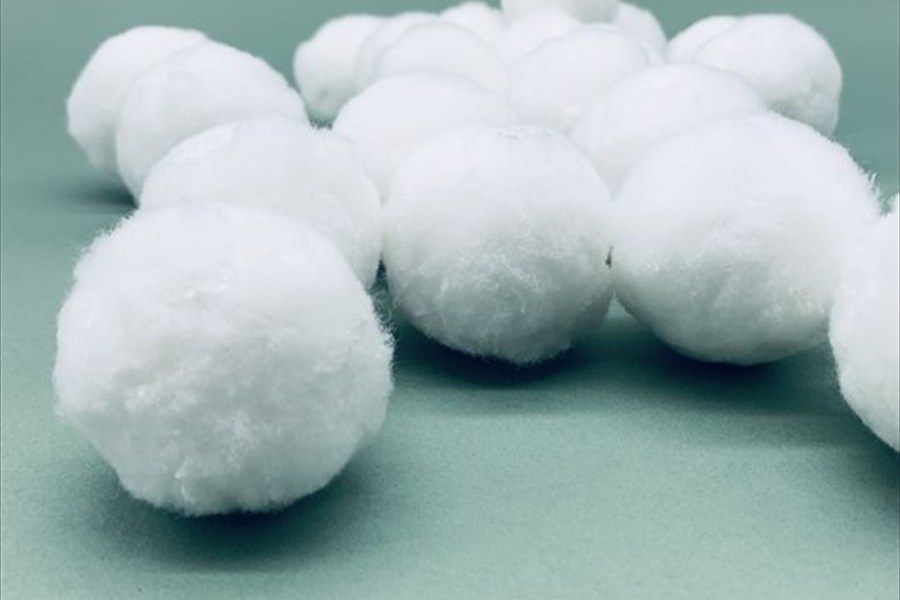
Why fibrous media took over from sand
A sand bed captures most of its solids in the top few centimetres. That is a consequence of the way the grains pack: the voids are uniform, so the first layer that sees the solids takes the load, blinds, and the head loss climbs until backwash is forced — even though most of the bed is still clean.
A fibrous bed behaves differently. At rest the filaments form a dense mat with a high void ratio; during backwash the bed expands and the filaments separate, releasing what they held. Because the structure is not uniform, capture happens through the depth. The practical result is a higher solids loading per square metre before breakthrough, and a longer run.
The three formats we make
| Media | Form | Where it fits |
|---|---|---|
| Fibre ball filter media | Balls of fine synthetic filaments, packed as a bed | General tertiary filtration, oil removal, and retrofits where a loose fill is easier to place |
| Comet fibre filter media | Graded fibre structure — coarse to fine through the bed | Duties where a single-grade bed blinds too fast; higher solids loading |
| Fibre bundle filter media | Aligned filament bundles anchored in a frame or plate | Deep bed filtration where the pore structure through the depth has to be predictable |
All three share the same design question — how much bed depth at what flow rate — and differ in how uniformly they hold their structure under repeated backwash.
What a graded bed actually does
Put coarse material where the water enters and fine material where it leaves. Large particles are caught early where the voids are big; fine material downstream is not blinded by them. Head loss builds more evenly and the run is longer.
The cost is that a graded bed is harder to backwash evenly, because the fine layer needs a lower backwash rate than the coarse one to avoid being carried out. That is the design tension, and it is why backwash rates have to be specified with the media rather than after it.
Oil removal, specifically
Fibrous media coalesces dispersed oil: droplets meet the filaments, merge, and leave the bed as larger droplets that separate more easily downstream. It works well, and it fails in one predictable way — if the backwash is not effective, the captured oil blinds the media permanently and the bed has to be replaced.
So if the duty includes oil, the backwash design is not a detail. Ask for the backwash water and air rates with the media quote.
What holds the bed up
Every filter bed needs something underneath it. Traditionally that was graded gravel; increasingly it is a nozzle plate.
- Graded gravel — cheap, proven, and it has to be re-layered if it is disturbed.
- Nozzle plate — an ABS filter nozzle grid in a concrete plate, or a cast-in-place plate. Gives a much more even backwash distribution and eliminates the risk of gravel mixing into the media.
Either way, the nozzle slot width or the gravel grading has to suit the media above it — that is the interface where beds fail.
What a filter media quote should contain
- Media type, fibre material and grade or layering
- Bed depth and the layer thicknesses if graded
- Service flow rate per unit area
- Backwash water and air rates, and the expansion expected
- Expected solids loading between backwashes
- The support arrangement below the bed, and the interface detail
A quote with only a media name and a volume cannot be checked against the duty, and the gap usually surfaces during commissioning.
Questions buyers ask
What is the difference between fibre ball and fibre bundle filter media?
A fibre ball is a loose ball of fine filaments, so the bed is a packed mass of individual spheres with voids between them. A fibre bundle is a set of aligned filament bundles held in a frame or anchored to a plate, so the bed keeps a directional structure. The ball form is easier to handle and cheaper to fill; the bundle form holds its shape better under backwash and gives a more predictable pore structure through the depth.
Why use fibrous media instead of sand?
A fibre bed has a much higher void ratio at rest and expands on backwash, so it captures solids through its depth rather than only in the top few centimetres. That means a higher solids loading per unit area before breakthrough, and a longer run between backwashes. Sand is still the right answer where the duty is simple, stable and cost-driven.
What does a graded fibre bed do?
It puts coarser material where the water enters and finer material where it leaves, so large particles are caught early and the fine material is not blinded by them. The result is a longer run and a more even head loss build-up than a single-grade bed. Comet fibre and graded fibre media are built on this principle.
Can fibre media be used for oil removal?
Yes, and it is one of the better uses. Fibrous media coalesces dispersed oil droplets as the water passes through, so the droplets grow and separate more easily downstream. The media then has to be backwashed effectively or the captured oil will blind it, so the backwash design matters as much as the media.
What should a filter media quote tell me?
Media type and fibre material, grade or layering, bed depth, service flow rate per unit area, backwash water and air rates, expected solids loading between backwashes, and the support arrangement below the bed. A quote that gives only a media type and a volume cannot be checked against the duty.