On this page
- The four jobs media does
- Media mapped onto treatment stages
- Biofilm carriers: MBBR, MBR and the hanging options
- Settling media
- Filter media
- Aeration is bought at the same time, not the same thing
- STP media versus ETP media
- How to size each one
- Six mistakes that repeat on every project
- Questions buyers ask
The four jobs media does
Before comparing products, separate the functions. They are sold by the same suppliers, often on the same quote, which is exactly why they get confused.
| Function | What the material does | Typical product names |
|---|---|---|
| Attached growth | Holds a biofilm in the reactor so the biomass stays put while the water passes through | MBBR media, biofilm carrier, bio ball, PU foam carrier, elastic packing, biological rope |
| Settling | Divides a clarifier into shallow settling cells so particles fall a short defined distance | Tube settler media, honeycomb tube settler, lamella plate, inclined plate media |
| Filtration | Retains solids that settling did not catch | Fibre ball, comet fibre, fibre bundle, filter nozzle and plate assemblies |
| Gas transfer | Dissolves oxygen into the mixed liquor, or strips gas out of it | Disc diffuser, tube diffuser, plate diffuser, single-orifice BAF diffuser, vortex aerator - and for stripping rather than dissolving, degassing packing (also sold as stripping tower packing, decarbonation packing or mesh packing) |
Media mapped onto treatment stages
A conventional sewage treatment plant runs the stages below. The right-hand column is the only thing this guide is really about.
| Stage | What happens | Media that belongs there |
|---|---|---|
| Primary settling | Gross solids settle out before the biology sees them | Usually none. Sometimes tube settlers in a retrofit where the existing tank is hydraulically short |
| Biological treatment | Organic matter and ammonia are oxidised | MBBR carriers, suspended ball media, sponge carriers, combined packing, elastic packing, biological rope |
| Anoxic / anaerobic zones | Denitrification and biological phosphorus removal | Hanging media, because they do not need aeration to stay in suspension. Carbon fibre water grass is used here |
| Secondary settling | Biomass is separated from treated water | Tube settler media, inclined plate media where the clarifier is the bottleneck |
| Tertiary filtration | Residual solids are polished out | Fibre ball, comet fibre, fibre bundle, plus the nozzle and plate that hold the bed up |
| Disinfection / reuse | Pathogens and residual load removed | No media, but this is where a membrane bioreactor earns its cost |
Biofilm carriers: MBBR, MBR and the hanging options
Attached growth is the largest and most misunderstood group. The reason to use it is simple: a biofilm tolerates load shocks and low temperatures better than suspended sludge, and it lets an existing concrete tank hold more biology without being rebuilt.
MBBR media — moving bed biofilm reactor carriers
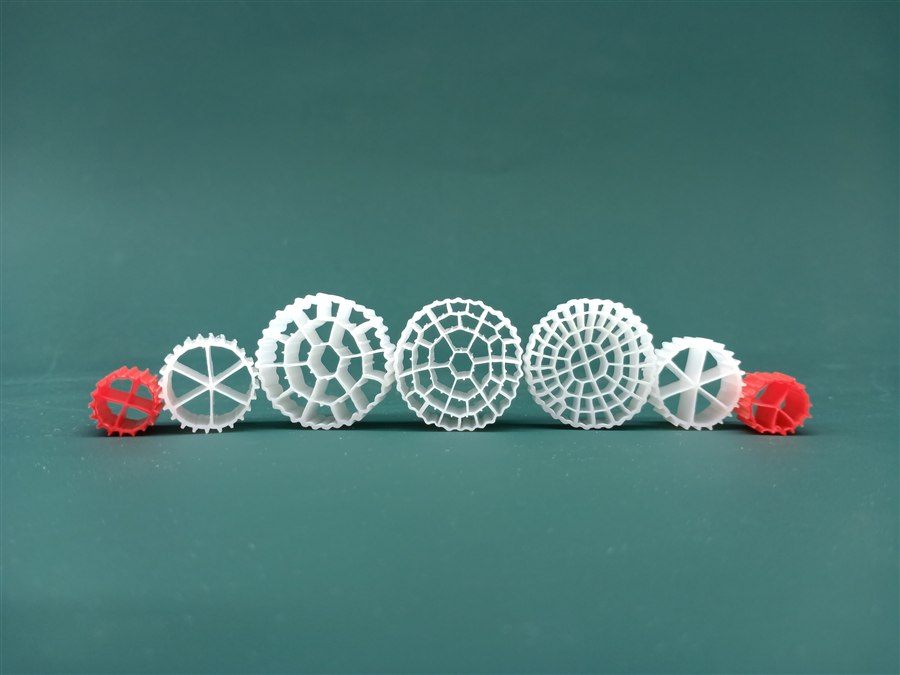
The carriers move freely in the aerated tank; the biomass grows on protected internal surfaces; a retention screen keeps the carriers in and lets the water out. Our range runs K1 through K5 from Φ10 mm to Φ25 mm in HDPE, with a specific surface area above 800 m²/m³ on the small types and above 1,000 on the high-surface variants, porosity above 85–90%, and a service life beyond 15 years. Nitrification rates fall in the 400–1,200 g N/m³·d band and BOD/COD oxidation in 2,000–15,000 g/m³·d, both depending on the load and the temperature.
The number that decides how much you buy is the fill fraction — the percentage of reactor volume occupied by carriers. It is a design output from the load you have to remove, not a figure to pick from a table, and it usually lands somewhere in the 15–67% window. The full method is in MBBR media calculation, and the MBBR media calculator does the arithmetic.
MBR media and membrane bioreactors
The phrase "MBR media" is loose. A membrane bioreactor is not a biofilm process — it is activated sludge with the clarifier replaced by a membrane. What people usually mean by "MBR media" is either the coarse bubble scouring diffusers that keep the membrane clean, or carriers used in a hybrid MBBR-then-membrane train. Both are real; neither is a membrane. The process comparison is set out in MBBR vs MBR.
Suspended, sponge and hollow ball carriers
Where the tank is shallow, the aeration is weak, or the duty suits a larger carrier, suspended formats take over. Suspended ball media is a hollow or multi-faceted sphere; multi-faceted hollow ball is the same idea with a larger protected surface; polyurethane sponge media carries a very high biomass per unit volume and is chosen where the load is high and the tank volume is not negotiable. Each carries a different surface area and fluidisation behaviour, so the fill fraction that worked for one is not transferable to another.
Hanging media
Hanging media is fixed on a frame rather than moving. That makes it the right choice for anoxic and anaerobic zones, which have no aeration to keep anything in suspension, and for low-energy plants: combined packing, elastic packing, biological rope and carbon fibre water grass. The trade-off is that the media cannot be removed and replaced without draining the tank, and the frame has to be designed with the media, not after it.
Settling media
Settling media does not treat anything. It shortens the distance a particle has to fall, which lets the same clarifier area handle a higher rise rate. Two geometries do the same job:
- Tube settlers — small hexagonal tubes installed at 60°, giving a large wetted perimeter in a compact module. Our range is Φ25 to Φ90 mm, 1000 × 500 × 1000 mm modules, with a design velocity V₀ of 2.5–3.0 mm/s and a hydraulic load of 3–5 t/m²·h. A plate-and-tube clarifier typically handles three to five times the flow of a plain horizontal settling tank of the same footprint, and two to three times a deep inclined-plate basin.
- Inclined plates — the same angle and the same shallow-cell principle, built from flat sheets. Cheaper per square metre of settling area and more prone to bridging where the sludge is fibrous.
The full comparison, including why the 60° angle is not arbitrary, is in tube settler vs lamella clarifier. Sizing is in the tube settler calculator.
Filter media
Filtration is where the media specs get tightest, because the medium has to both capture solids and release them on backwash. Fibrous media dominate because a fibre bed has a high void ratio at rest and expands during backwash, so it captures deep rather than only at the surface: fibre ball filter media, comet fibre filter media and fibre bundle filter media.
Whatever sits above the plate needs something to sit on. That is the filter nozzle and the plate that carries it — either a precast concrete plate or a cast-in-place plate. The nozzle grid and the plate thread have to be decided together, because the sockets are cast in and cannot be changed afterwards. If you want the nozzle count for a given plate and grid, the filter nozzle count calculator works it out from the plate plan.
Aeration is bought at the same time, not the same thing
A diffuser is not media. It is a gas transfer device, and it is quoted alongside media because the two together define the biological stage. The reason to keep them separate in your head: media is sized from the load, aeration is sized from the oxygen demand plus the mixing requirement, and the two calculations fail in different ways.
The full treatment, including disc, tube, plate, single-orifice and vortex formats, is in the companion article aeration diffusers compared.
STP media versus ETP media
These two terms get used as if they describe different products. They describe different duties, and the same catalogue serves both.
| STP — sewage treatment plant | ETP — effluent treatment plant | |
|---|---|---|
| Feed | Domestic sewage: dilute, consistent, predictable | Industrial effluent: variable, sometimes aggressive |
| Sizing driver | Population, flow and standard | The worst thing the factory can legally discharge |
| Material risk | Low — PP, HDPE and EPDM are generally adequate | High — solvents, oils, extremes of pH and temperature decide the polymer |
| Typical configuration | Primary → MBBR or ASP → secondary clarifier → tertiary filter | Equalisation → chemical or biological treatment → clarification → polishing |
| Where it goes wrong | Clarifier sized on the old flow after a capacity upgrade | Media specified from the sewage catalogue without checking the waste stream |
The stage-by-stage version with our product links is in media for STP and ETP.
How to size each one
Every serious sizing question reduces to one of four sums. Learn these four and most quotes become checkable.
- Settling media — settling area from peak flow divided by the surface loading rate, then media volume from area times stack height.
- Biofilm carriers — volumetric load divided by the design removal rate, run for each parameter, take the largest answer, then check it against the fill-fraction window.
- Filter nozzles — plate plan divided by the nozzle grid, one nozzle per cell.
- Aeration — oxygen demand from the load, divided by the transfer rate at your tank depth.
Three of the four have free calculators on this site; the fourth needs the tank depth and the diffuser data in front of you. The unit conversions that catch people out in these sums — m³/h to gpm, mg/L to ppm, bar to metres of water — are in the unit converter.
Six mistakes that repeat on every project
- Buying carriers to fix an aeration shortfall. More biomass means more oxygen demand. If the blowers and diffusers cannot feed it, the carriers make the plant worse, not better.
- Sizing settling media on average flow. Clarifiers fail at peak. Use the peak the plant will actually see, including storm return.
- Specifying a fill fraction from a catalogue. Two plants with the same tank volume and different influent need different carrier volumes. That is arithmetic, not preference.
- Choosing a polymer from the sewage catalogue for an industrial stream. The single most expensive mistake in this list, because it is only discovered after installation.
- Forgetting the retention screen. Carriers leave a tank through the outlet exactly once, and it is the day after commissioning.
- Treating the nozzle grid as a detail. Sockets are cast into concrete. Changing a grid after the pour is a demolition job.
Questions buyers ask
What is wastewater treatment media?
It is the physical material placed inside treatment tanks to give the process somewhere to happen. Three families: biofilm carriers, which hold attached biomass in a biological stage; settling media, which divide a clarifier into shallow settling cells; and filter media, which retain solids. Aeration diffusers are the fourth element usually bought at the same time, though they move gas rather than grow biology.
What is the difference between STP media and ETP media?
The hardware is largely the same; the duty is not. STP media handles domestic sewage, which is dilute and consistent, so carriers and settling media can be sized from population and flow. ETP media handles industrial effluent, which can carry solvents, oils, extremes of pH or temperature, so the material choice usually matters more than the geometry and the design has to survive whatever the factory discharges.
How do I choose between MBBR media and a membrane bioreactor?
MBBR adds biofilm surface area to an existing tank and still needs a clarifier or filter downstream. A membrane bioreactor replaces the clarifier with a membrane and produces reuse-grade water. If the permit is met by a well-run clarifier, MBBR is the cheaper route; if the site is tight or the water is reused, the membrane is not optional.
Can media fix an overloaded treatment plant?
It can raise the biological capacity of an existing tank, which is the usual reason carriers are bought. It cannot fix a shortfall in aeration capacity or a clarifier that cannot return the extra solids. Those two checks decide more retrofits than the carrier choice does, and they should be done before any quantity is agreed.
Is trickling filter media still used?
Yes, and it is still specified for small works, for load levelling ahead of a trickling filter, and where energy cost matters because a trickling filter needs no process air. Random plastic packing has largely replaced crushed rock because it gives a far higher surface area per cubic metre and does not blind as quickly.