Coagulation and flocculation are not the same stage
They are separated by an order of magnitude in time and by opposite mixing requirements:
| Coagulation | Flocculation | |
|---|---|---|
| What happens | Particles are destabilised so they can stick | Destabilised particles are brought into contact so aggregates grow |
| Time scale | Seconds | Minutes |
| Mixing | Rapid and intense | Gentle and sustained |
| Failure mode | Under-mixed: coagulant does not disperse | Over-mixed: floc is sheared apart before it can settle |
Why geometry rather than paddles
Mechanical flocculators use paddles to stir. Hydraulic flocculators use the shape of the channel to make the water stir itself. The hydraulic version has no moving parts to maintain, no gearbox in a wet environment, and no energy cost beyond the head loss — which is why it dominates where the head is available.
The mechanism in both cases is the same: repeatedly contract and expand the flow so the velocity gradient alternates. Particles are brought together during the contraction and the aggregate is allowed to recover during the expansion.
The equipment, and what each does
| Equipment | Mechanism | Where it fits |
|---|---|---|
| Flocculation grid | A grid of openings creating repeated contractions | Retrofits and rectangular basins with available head |
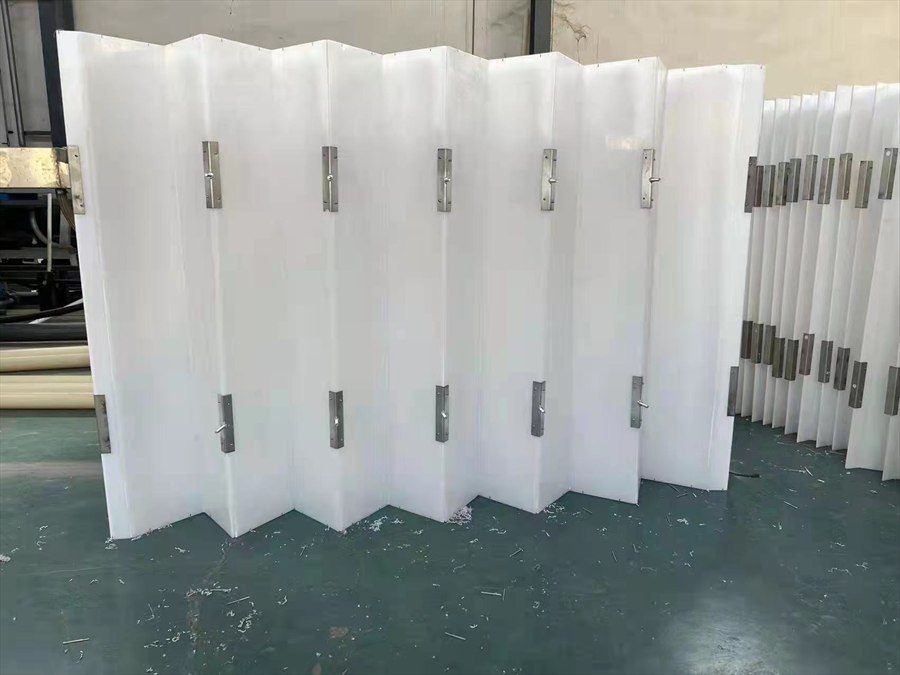
| Flocculation baffle box | Folded plates whose folds alternately contract and expand the flow, generating micro-vortices | Compact modules for concrete basins or channels; the plate count per section is calculated from the geometry |
| ABS flocculation ball | Local eddy generation inside an existing stage | Modifying the mixing in a stage that has already been designed |
| Collection trough | V-notch weir or perforated wall collecting settled water evenly | The outlet of the clarifier — sets the flow distribution over the settling area |
The plate count in a baffle box
The number of folded plates in one section is not a catalogue figure. It is the clear width of that section divided by the fold pitch plus the clear gap between plates.
Because each stage in the train runs slower than the one before, the pitch usually opens up along the train and the plate count falls with it. The flocculator plate calculator runs the division and shows the remainder to the wall, which matters because a gap at the wall is a short-circuit path.
The part everyone forgets: the trough
Everything upstream can be perfect and the clarifier will still carry solids over if the collection troughs are wrong. The trough sets the flow distribution across the whole settling area:
- Too few troughs — the water has to travel further in some parts of the basin than others, so the effective rise rate is not uniform.
- Inaccurate weir crest — a few millimetres of level error across a long trough is a measurable flow imbalance.
- Weir loading too high — local upward velocity near the trough draws solids over the edge.
A V-notch weir trough is chosen over a plain wall precisely because each notch fixes its own crest, so the total flow divides more evenly even if the trough is not perfectly level.
Questions buyers ask
What is the difference between coagulation and flocculation?
Coagulation destabilises particles so they can stick together - it is a chemical and rapid-mix step measured in seconds. Flocculation gives those destabilised particles gentle, sustained contact so the aggregates grow large enough to settle - it is a hydraulic step measured in minutes. They need opposite mixing intensities, which is why they are separate stages and why confusing them is one of the most common design errors.
What does a flocculation grid do?
It creates repeated contractions and expansions in the flow so the velocity gradient changes along the path. That alternation is what builds floc without shearing it: strong enough contact to make particles meet, gentle enough not to break the aggregate that has already formed.
What is a folded plate flocculator?
Also called a flocculation baffle box. Flow passes through a channel formed by folded plates, and each fold alternately contracts and expands the flow area, generating micro-vortices that promote particle contact. The plate count per section follows from the clear width divided by the fold pitch plus the gap - which is why the number is an output of the geometry, not a catalogue figure.
Do flocculation balls work?
Yes, as a micro-vortex generator inside a flocculation stage rather than as a biofilm carrier. The balls disturb the flow locally and create small eddies that increase particle collisions. They are not a substitute for the stage geometry - they modify the local mixing in a stage that has already been designed.
Why does the collection trough matter so much?
Because it sets the flow distribution over the whole settling area. If the troughs are too few, too far apart, or the weir crest is inaccurate, some of the clarifier runs faster than design and some runs slower. The faster part carries solids over no matter how good the settling media is.