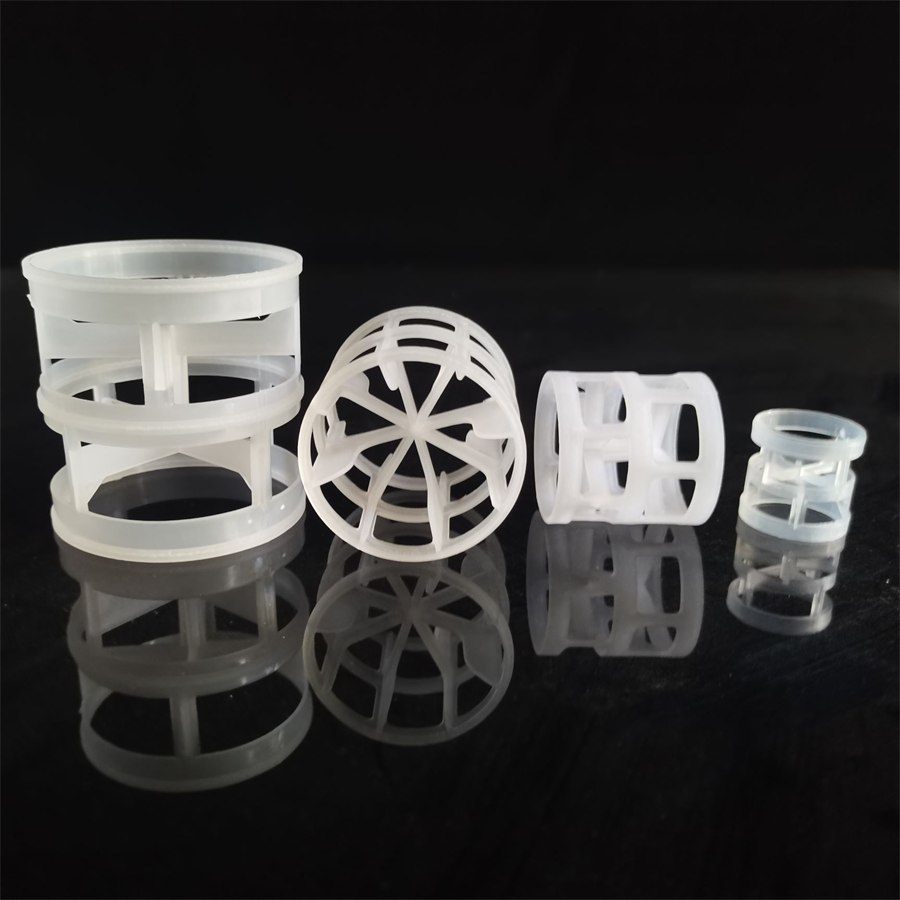
The trade-off that governs everything
Every packing decision balances three quantities that cannot all be maximised:
- Specific surface area — more surface means more contact and better mass transfer.
- Void ratio — more void means lower pressure drop and less fouling, but less surface.
- Pressure drop — what you pay in fan or blower energy, and what limits the gas rate before flooding.
A packing with very high surface area almost always narrows its passages, so it fouls sooner. A very open packing has a low pressure drop and resists fouling but needs more volume to achieve the same transfer.
The formats we make
| Packing | Geometry | Character |
|---|---|---|
| Pall ring | Cylinder with internal tongues | The general-purpose random packing. Metal 16–76 mm, plastic 16–76 mm, ceramic 25–80 mm. Voids roughly 70–95% depending on material and size |
| Hacketten / Tri-Pack | Open triangular frame lattice | Very high void ratio, very low pressure drop, little enclosed volume to foul |
| Teller rosette ring | Radiating vanes around a central hub in an outer ring | Open moulding with no flat plate; used in scrubbing, stripping and odour control |
| Multi-faceted hollow ball | Polyhedral hollow sphere | Large protected surface with an open structure; also used as a carrier |
| Degassing packing | Open mesh geometry | Maximum contact area at minimum pressure drop for stripping duties |
Pall ring, and why it replaced the Raschig ring
A Raschig ring is a plain hollow cylinder. Liquid falling through it tends to run down the walls and the inner surface goes dry, so much of the surface you paid for does nothing.
A Pall ring adds internal tongues that catch the falling liquid and throw it back across the gas path. The inner surface stays wet, so the effective area is much closer to the geometric area. That single change is why Pall rings became the default random packing.
Material choice
| Material | Choose it when | Watch out for |
|---|---|---|
| PP / R-PP / CPVC / PVDF / PFA | Normal temperatures with aggressive chemistry | Temperature limits of the resin; some grades soften earlier than expected |
| Stainless steel | Higher temperature, or where mechanical strength matters | Cost; and chloride attack in some grades |
| Carbon steel / aluminium alloy | Benign chemistry and cost-driven projects | Corrosion in anything wet and aerated |
| Ceramic | High temperature and solvent resistance together | Weight, fragility, and a lower void ratio for the same nominal size |
Degassing and stripping
Stripping towers remove dissolved gas rather than absorbing it. Carbon dioxide in a demineralisation train, hydrogen sulphide in odour control, and dissolved oxygen in some duties all use the same principle: give the falling water and the rising air the largest possible contact area at the lowest possible pressure drop.
Because pressure drop matters more than raw surface area here, open mesh and open-lattice geometries dominate. A dense packing with a high surface area would give more contact but cost more fan energy than the transfer gain is worth.
Choosing, in order
- What is being transferred, and in which direction? Absorption, stripping or scrubbing. This sets the required surface area more than anything else.
- What is in the gas or liquid that can foul? If the answer is "solids, tar or polymer", open geometries win before efficiency is discussed.
- What temperature and chemistry? This picks the material, and the material often picks the size range available.
- What pressure drop can the fan afford? That sets the void ratio, and the void ratio sets the geometry.
- How deep is the bed? Deeper beds need better liquid distribution at the top to avoid channelling.
Questions buyers ask
What is the difference between random and structured packing?
Random packing is individual shaped elements tipped into the tower, so the internal geometry is whatever the pieces happened to form. Structured packing is built from repeated units so the flow path is predictable. Structured packing gives a lower pressure drop per unit of surface area and a more even liquid distribution, but it costs more and tolerates solids far less well.
What is a Pall ring used for?
Absorption, scrubbing, stripping and degassing towers. It is a cylinder with internal tongues that redistribute the falling liquid and re-expose fresh surface, which is what made it an improvement on the plain Raschig ring. It is a random packing, available in metal, plastic and ceramic, and the material is chosen by the chemistry.
What is Hacketten packing also called?
Tri-Pack, open-frame packing or triangular packing ball. It is an open lattice of triangular frames rather than a closed ring, which gives a very high void ratio and a low pressure drop. That makes it suited to duties where fouling is a risk, because there is little enclosed volume for solids to collect in.
When should I use ceramic rather than plastic packing?
When the temperature or the chemistry rules the polymer out. Ceramic holds its shape at temperatures plastics cannot, and it resists solvents that attack PP or PVDF. It is heavier, more fragile in handling, and it has a lower void ratio for the same nominal size, so the pressure drop is higher.
What does degassing packing do?
It strips dissolved gas from water in a packed tower - carbon dioxide in demineralisation trains, hydrogen sulphide in odour control, and dissolved oxygen in some duties. The packing's job is to give the largest possible contact area between falling water and rising air at the lowest pressure drop, which is why open mesh geometries dominate this duty.