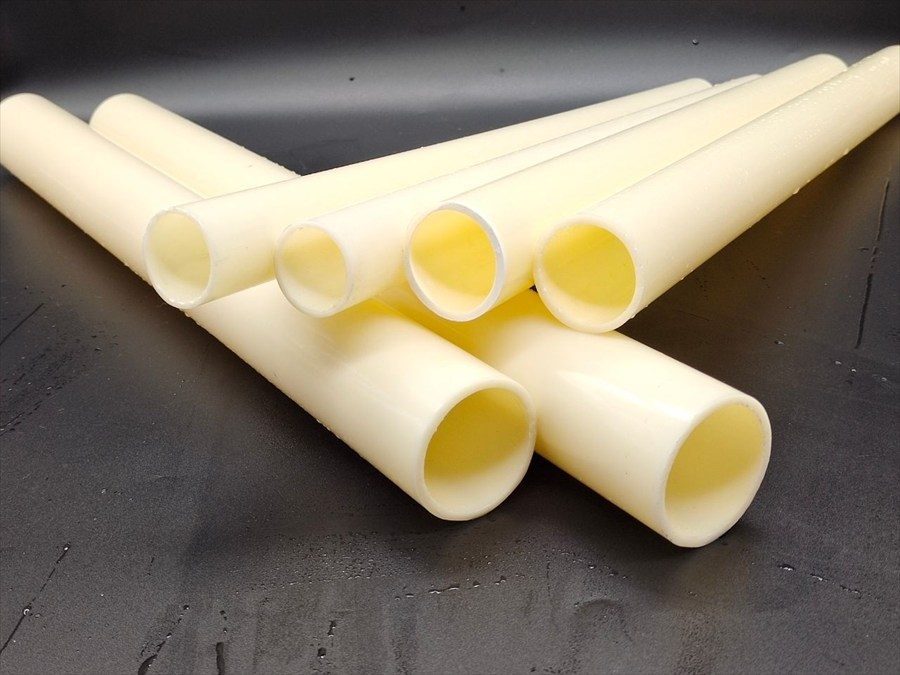
What the three monomers actually do
ABS is a terpolymer, and each monomer contributes a property that the other two cannot give alone.
| Monomer | Contributes |
|---|---|
| Acrylonitrile | Chemical resistance and rigidity |
| Butadiene | Impact toughness — the reason ABS survives being dropped and hit |
| Styrene | Machinable, glossy surface; the reason it threads and taps cleanly |
Typical density is 1.04–1.07 g/cm³. The balance of the three is why one ABS grade is stiffer and another tougher, and why "ABS" alone is not a complete specification.
ABS against PVC
| ABS | PVC | |
|---|---|---|
| Impact | Good — tolerates site handling | Brittle, especially in cold weather |
| Threading and tapping | Clean and dimensionally stable | Threads poorly; usually needs inserts |
| Stiffness | Lower — needs more supports | Higher |
| UV | Needs stabilised grade outdoors | Also degrades outdoors |
The practical rule: PVC where the run is long, protected and cheap; ABS where the pipe is threaded, hit, or has to hold a fitting precisely. That is why filter plates are tapped for ABS nozzles.
Where ABS belongs in a treatment plant
- ABS pipe — aeration airlines, sampling lines, chemical-duty runs and drainage where impact is likely
- Flame retardant ABS pipe — enclosed spaces, plant rooms and anywhere the fire strategy constrains the material
- ABS filter nozzle — the threaded distribution element in a filter plate, where ABS is chosen precisely because it threads and holds dimension under load
- ABS flocculation ball — media in a flocculation stage, where the material has to keep its geometry while generating micro-vortices
The three failures that actually happen
- Solvent-weld joints. Too much gap between pipe and socket, or too little cement, or movement during cure. This is the single most common ABS failure and it has nothing to do with the material.
- Over-tightened threads into plastic. A taper thread tightened until it "feels right" splits the socket. Use the specified sealant and stop at hand-tight plus a quarter turn.
- Unsupported spans. ABS is less stiff than PVC, so it flexes at every fitting if the supports are spaced as though it were steel. The joint then works loose over a few seasons.
Questions buyers ask
What is ABS pipe made of?
Acrylonitrile butadiene styrene - a terpolymer of three monomers. Acrylonitrile contributes chemical resistance and rigidity, butadiene contributes impact toughness, and styrene contributes the glossy machinable surface. Typical density is 1.04-1.07 g/cm3. The balance of the three is what makes one grade stiffer and another tougher.
Why is ABS used instead of PVC in treatment plants?
Impact toughness and machinability. ABS resists the knocks that aeration pipework takes during installation and maintenance, and it threads cleanly, which is why filter plates are tapped for ABS nozzles rather than for softer plastics. PVC is stiffer and cheaper per metre, and it is the right answer where the run is protected and long.
What is flame retardant ABS?
An ABS grade with additives that resist ignition and slow flame spread. It is specified where the pipework runs in an enclosed space, near electrical equipment, or wherever the fire strategy requires a certain class of material - typically aeration and sampling lines inside a building rather than buried or outdoor runs.
Does ABS pipe degrade in sunlight?
Unstabilised ABS will chalk and embrittle with prolonged UV exposure. Buried and indoor runs are unaffected. Where pipe has to be stored or installed outdoors for long periods, specify a UV-stabilised grade or protect the run, because embrittled pipe fails at the joint rather than in the wall.
What causes ABS pipe failures in service?
Three things, in order of frequency: solvent-weld joints made with too much gap or too little cement; over-tightening threaded connections into plastic; and unsupported spans that let the pipe flex at every fitting. Almost none are the pipe material itself.