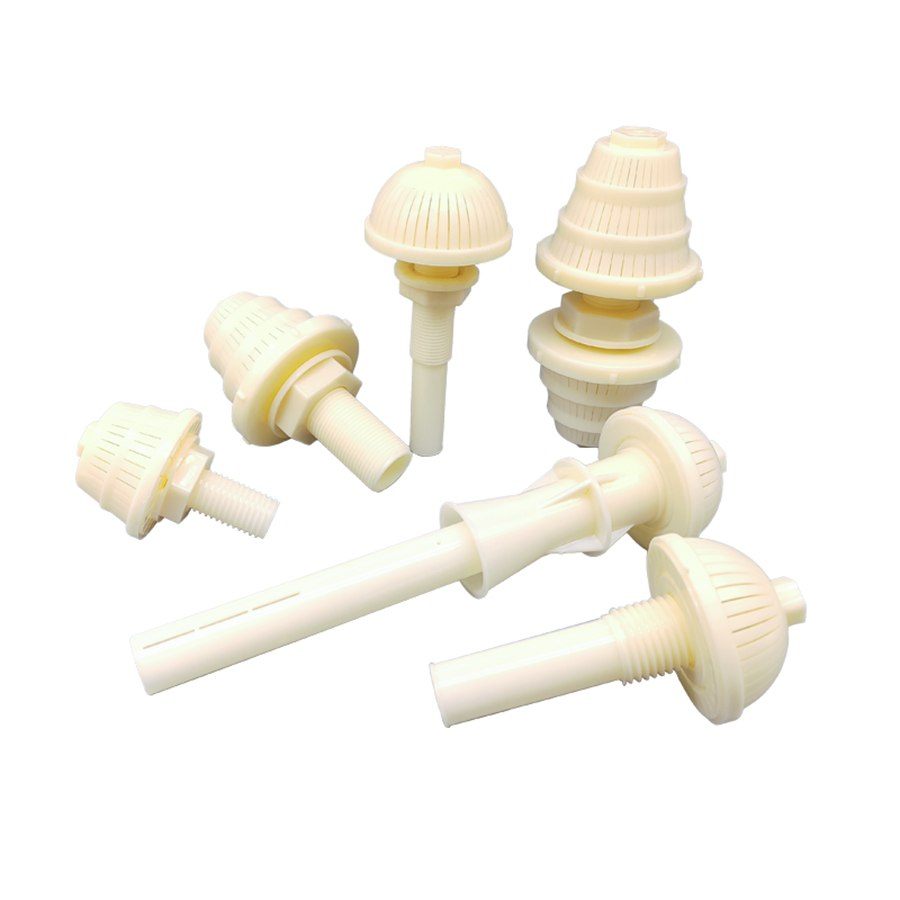
The four parts, and why they are one decision
| Part | Job | What fixes it |
|---|---|---|
| Nozzle ABS filter nozzle | Retains the media and spreads service flow and backwash air/water evenly | Slot width suits the media above; head shape spreads the flow |
| Plate concrete / cast in place | Carries the nozzles and separates the media bed from the plenum | Construction method decides which type; the tank decides the plan |
| Sockets | Receive the nozzles | Cast or formed into the plate — the thread is fixed for the life of the plate |
| Plenum | Distributes backwash water and air beneath the plate | An uneven plenum produces uneven backwashing regardless of nozzle quality |
Nozzle types
Two head families cover most duties, with four stem and handle options crossing them.
- Tower head — a taller stack of slots, giving more open area in a compact footprint. Suits higher flow per nozzle.
- Mushroom head — a wide, low cap. Suits shallow media beds and duties where the nozzle has to sit close to the surface.
- Stem options — long handle, short handle, double-head and adjustable. Long handle is the common choice where the nozzle has to be reachable above the media during maintenance.
The head and the stem are usually specified together as one part number, because the thread is on the stem and the flow behaviour is in the head.
The nozzle grid
The grid is the number of nozzles per square metre, and it follows from two spacings. It is decided by three competing requirements:
- The media above. The support layer has to be able to bridge the gap between nozzles without falling through.
- Backwash air and water rates. The nozzle open area has to pass the backwash without excessive pressure.
- The plate. Every nozzle is a hole in the concrete, so the load between them has to be carried.
The filter nozzle count calculator turns a plate plan and two spacings into nozzles per plate, per square metre and per battery.
When it is not a nozzle plate at all
| Alternative | What it is | When it wins |
|---|---|---|
| Underdrain filter brick | Moulded blocks forming the plenum and the media support in one | Shallow tanks, and new builds where a separate plenum void is expensive |
| Bread pipe (U-section) | U-section distribution pipe under the bed | Rebuilding an underdrain without breaking out the floor |
| Stainless steel drain cap | Metal nozzle where the polymer is not suitable | Aggressive chemistry or high temperature |
How the bottom of a filter fails
- Media in the plenum. Slot width too wide for the support layer, or a nozzle cracked during installation.
- Uneven backwash, one corner dirty. Plenum distribution, not the nozzles. Check the plenum before ordering parts.
- Cracked sockets. Over-tightening at installation, or a plate designed for too thin a section.
- Nozzles pulled out. Wrong thread engagement — usually a mismatch between a nozzle specified late and a plate specified early.
- Biological growth in the slots. Long residence times in warm service; a sign the filter is being run as a reactor.
Questions buyers ask
What is a filter nozzle and what does it do?
A filter nozzle, also called a strainer nozzle or water cap, is the distribution element threaded into a filter plate. It forms one flow path between the plenum below and the media bed above. In service, filtered water passes down through its slots. In backwash, water and air are spread upward across the whole plate through the same slots. Slot width retains the media; head shape spreads the flow.
Which is better, a concrete filter plate or a nozzle plate?
They are usually the same thing described differently. A filter plate is the horizontal structure that carries the nozzles and separates the media bed from the plenum. It can be precast concrete, cast in place, or a fabricated assembly. The choice is about construction method and the tank, not about performance: cast in place suits new tanks with a clean plan, precast suits retrofits and fast installation.
Why do the nozzle and the plate have to be specified together?
Because the socket is cast or formed into the plate. The thread, the socket depth and the grid spacing are fixed once the plate exists. Changing a nozzle thread afterwards is not a component swap, it is a demolition job. This is also why the nozzle grid should be settled before any concrete is poured.
What is an underdrain block or filter brick?
A moulded distribution block laid across the tank floor which forms both the plenum and the support for the media, with internal channels distributing backwash water and air. Compared with a nozzle plate it removes the need for a separate void, so the tank can be shallower. The trade-off is that the block profile has to suit the tank layout and the backwash duty.
What is a bread pipe in a filter?
It is the U-section distribution pipe used under a filter bed, shaped like a loaf in cross section, which is where the name comes from. It distributes backwash water and collects filtered water, and it is an alternative to a nozzle plate where the underdrain is to be rebuilt without breaking out the floor.